

What’s the Right Luggage Buying Strategy for Retailers & Supermarkets?
The right luggage buying strategy starts with minimizing return risk and maximizing landed-margin throughput—not chasing the lowest unit price. Many promo weeks fail because materials, sizes, and packaging don’t match real shoppers or shelf realities.1 I fix this by aligning material–use-case fit, SKU mix, cube-optimized packaging, and QC gates to promo timelines.
The right luggage buying strategy for retailers and supermarkets is to align material–use-case fit, SKU mix, volumetric-weight packaging, and QC gates to your promo window, so you reduce return rates and protect landed margin. Don’t chase the lowest FOB; manage cube, damage, and complaint risk tied to ABS/PC/PP/RPET and shopper profiles.
You now have the short answer. The details matter even more on a busy endcap or aisle during a traffic-driver promo. Below I share the exact frameworks I use with supermarket buyers—grounded in factory QC logs, packaging calculations, and real complaint patterns segmented by material and price band.
How should material–use-case fit shape your luggage buying strategy?
Retailers often assume there’s a universal “best” material.2 The problem is different shoppers and price bands create different failure patterns. Returns spike when material choice and use case don’t match.3 The solution is to map materials to shopper intent, promo price points, and risk patterns before locking SKUs.
Match ABS/PC/PP/RPET to shopper use cases and promo price bands, not a one-size-fits-all ranking. Use a Good–Better–Best ladder with 20"/24" as your traffic drivers and 28" as a margin protector. Link each material to known failure modes to pre-empt returns with design tweaks and QC gates.

Dive deeper
I sit on both sides of this: on our factory floor and in retail back rooms checking returns. Across projects from 2021–2025, our QC logs and after-sales notes consistently show that “wrong fit” is the root cause of many promo returns. Here’s how I translate it into Good–Better–Best logic without pretending there’s a universal hierarchy.
Known complaint patterns by material and price band
- ABS (entry-level):
- Common risks: shell cracking at corners under drop, wheel flat spots on rough pavements, zipper burst if overpacked.
- Fix levers: thicker corner radius, better wheel material, #10 zippers, tighter QC on shell thickness.
- PC (mid to upper):
- Common risks: surface scuff visibility, handle wobble if tube walls are thin.
- Fix levers: textured finishes, higher wall tubes, internal anchoring plates for handles.
- PP (upper mid to premium):
- Common risks: lid deformation if under-reinforced, latch alignment.
- Fix levers: rib design, tighter fit tolerances, reinforced latch mounts.
- ABS+PC film (mid):
- Common risks: film peeling on impact points, zipper stress near hinge side.
- Fix levers: bonded film QA, corner caps, balanced shell.
- RPET/Softshell (varies by denier):
- Common risks: abrasion at corners, seam fatigue near handle base, zipper burst under overfill.
- Fix levers: corner piping, bar-tack reinforcements, #10 zippers with double sliders.
I never decide material by “bestness.” I start with shopper intent:
- Occasional weekenders, price-sensitive: ABS 20"/24" with upgraded wheels and #10 zippers.
- Family holiday buyers, value seekers: PC 24" as the hero, ABS 20" as entry, PP 28" as restrained upsell.
- Heavy use, frequent flyers: PP 24"/28" or premium PC with higher spec handles, anti-scuff finishes.
- Eco-conscious niche: RPET fabric 20"/24" with hard frames and reinforced corners, but only if price band allows upgraded seam reinforcement.
Good–Better–Best ladder and mix template
- 70% Good (traffic driver):
- 20" ABS or ABS+PC with upgraded wheels and #10 zippers.
- Finish: matte/texture to hide scuffs.
- Colors: limit to 2 core plus 1 seasonal accent.
- 20% Better (upsell):
- 24" PC with textured shell and solid telescopic handle tubes.
- Finish: brushed or micro-diamond.
- Colors: 2 core.
- 10% Best (margin protector, not volume):
- 24"/28" PP or premium PC with reinforced ribs, latch/two-way zipper.
- Limit colorways to 1–2 to protect working capital.
I suggest the following sizes and price-point anchors for promo:
- 20" as entry, visible hero at front of aisle.
- 24" as the upsell staple, placed at hand height.
- 28" restrained, placed higher or on endcap side to signal premium while protecting margin.
This policy keeps shoppers from overbuying 28" during promos (which raises damage and zipper-burst risk when overloaded). It also saves returns when someone’s weekend trip doesn’t need a giant case.
A simple template you can copy
- Promo endcap/aisle:
- 70% 20" ABS/ABS+PC, matte, two core colors + 1 accent.
- 20% 24" PC, textured, two core colors.
- 10% 24"/28" PP or high-spec PC, 1–2 colors.
- Limit total colorways to 4–5 max for speed and replenishment clarity.
- Require mixed-pack MOQs aligned to shelf facings to avoid backroom congestion.
Tie this to qualification: in our pre-shipment tests, we increase cycle counts for handles on PP/PC upsell SKUs and raise drop-test height for ABS entries with reinforced corners. During one 2023 promo, this alone prevented a repeat of prior wheel flat-spot complaints we saw on an older ABS spec.
How does packaging and cube factor into a luggage buying strategy?
FOB looks good on paper and bad on your P&L when volumetric weight and damage shrink kick in. The problem is many promo packs ship with inefficient nesting and oversized cartons. The solution is to optimize nesting, carton dimensions, and protection so landed margin reflects reality.
Optimize for volumetric weight and shelf reality, not FOB. Nest cases tightly, minimize outer box size, and protect handles/wheels to reduce DIM weight and in-transit damage. A small change in carton dimensions can shift landed margin more than a few cents of FOB.

Dive deeper
I learned this the hard way on a rainy dock in Jiaxing. Two identical endcaps with different cartons yielded different profits.4 The slimmer cartons delivered more units per pallet, fewer dents, and lower DIM charges. Since then, our buyers ask me for a cube-ready packaging spec before we quote.
The math you can’t ignore
For air/small parcel:
- Volumetric weight (kg) = (L x W x H in cm) / 6000 or 5000 (depends on carrier/divisor).5 For ocean:
- Charge by CBM: CBM = (L x W x H in meters).
Two levers dominate:
- Carton size and nesting efficiency.
- Handle/wheel protection that prevents rework or returns without bloating the carton.
Before/after packaging optimization framework
Use this sensitivity sheet with your real numbers:
- Inputs:
- Unit dimensions (nested set or singles).
- Carton dimensions (L, W, H), pack count.
- Route (air vs ocean), DIM divisor or CBM rate.
- Promo markdown percent.
- Outputs:
- Volumetric weight per carton.
- Units per pallet/CBM.
- Landed cost per unit after freight and markdown.
- Sensitivity: +/- 1 cm in carton dims; +/- 10% markdown.
Illustrative calculation logic (replace with your PO data):
- If a 3-piece nested set reduces carton height by 2 cm through revised handle-stow design, the volumetric weight may drop by ~3–5% depending on dimensions. In my projects, that range alone can offset more than a $0.10 FOB difference on mid-tier sets when shipped by air for emergency top-ups.
I keep a simple calculator:
Table: Volumetric-weight margin sensitivity (example logic)
- Columns: Scenario, Carton L x W x H (cm), Vol. weight kg (divisor 6000), Units/carton, Freight/kg, Freight/unit, Est. damage %, Adjusted landed/unit.
- Rows: Baseline carton; Optimized carton; Add handle guard; Add corner caps.
I often see “Optimized carton” improve vol weight by several percent while reducing transit scuffs because the handle sits in a recess rather than protruding. This reduces both freight and shrink in one move.
Display-ready packaging checklist
- Shelf speed:
- QR/barcode on front/top.
- Easy-open strip for quick merchandising.
- Tamper-evident but not over-taped.
- Anti-theft:
- Cable-tie through zippers with hang tag.
- Hidden RFID/soft tag space if your loss-prevention requires.
- Protection without bulk:
- Wheel cups or corrugated inserts to lock wheels.
- Telescopic handle stowed and strapped to avoid wobble.
- Edge protectors only at stress points.
I won’t pretend one carton fits all. For promo replenishment by air, use thin but strong honeycomb inserts and optimized nesting. For ocean, balance CBM with stiffness so cartons stack with minimal crushing. In one hypermarket program, we cut repack time by using display-ready cartons that moved straight to the aisle—no extra wrapping—and that improved sell-through in week one.
What promo architecture sells fast and keeps returns low?
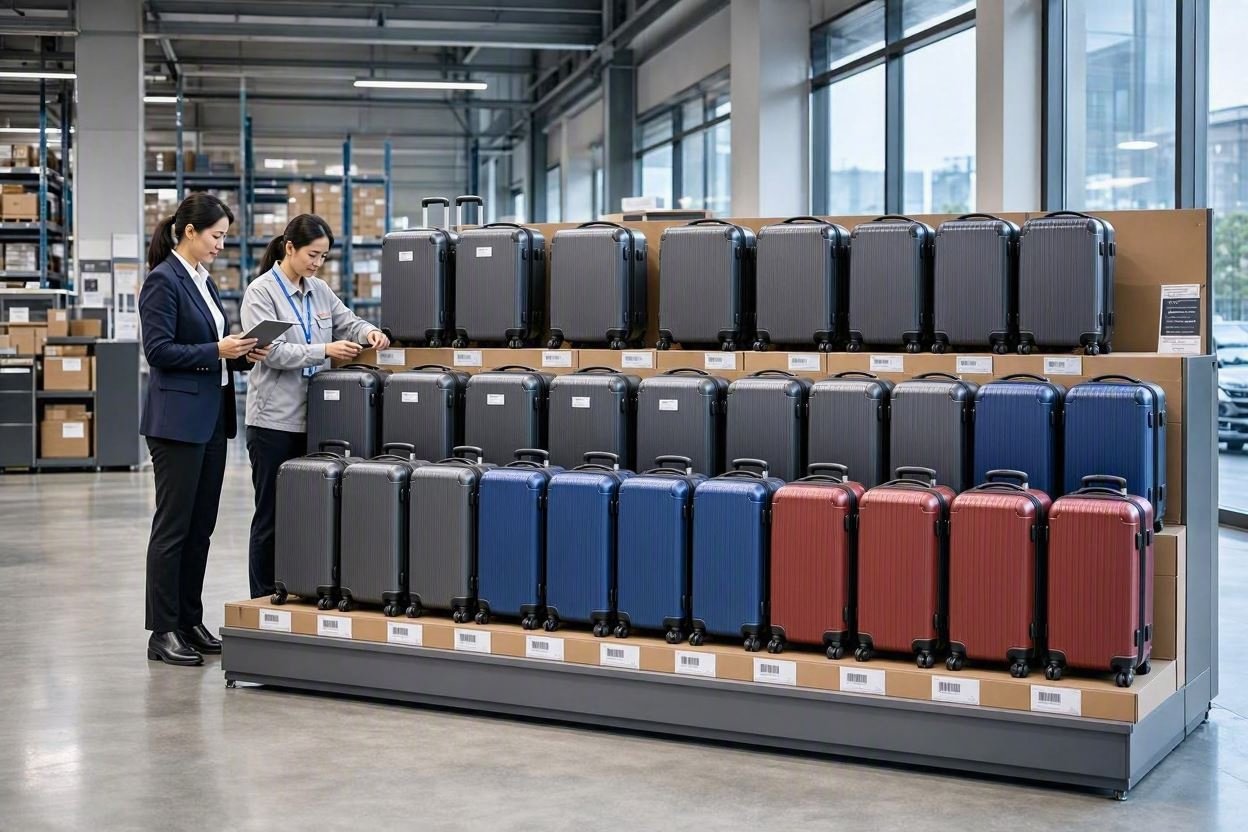
Many promos fail because assortments try to please everyone. That causes slow turns and messy shelves. The fix is a focused promo architecture: 20"/24" as traffic drivers, limited 28" to protect margin, capped colorways, mixed-pack MOQs keyed to facings, and packaging designed for loss prevention and speed.
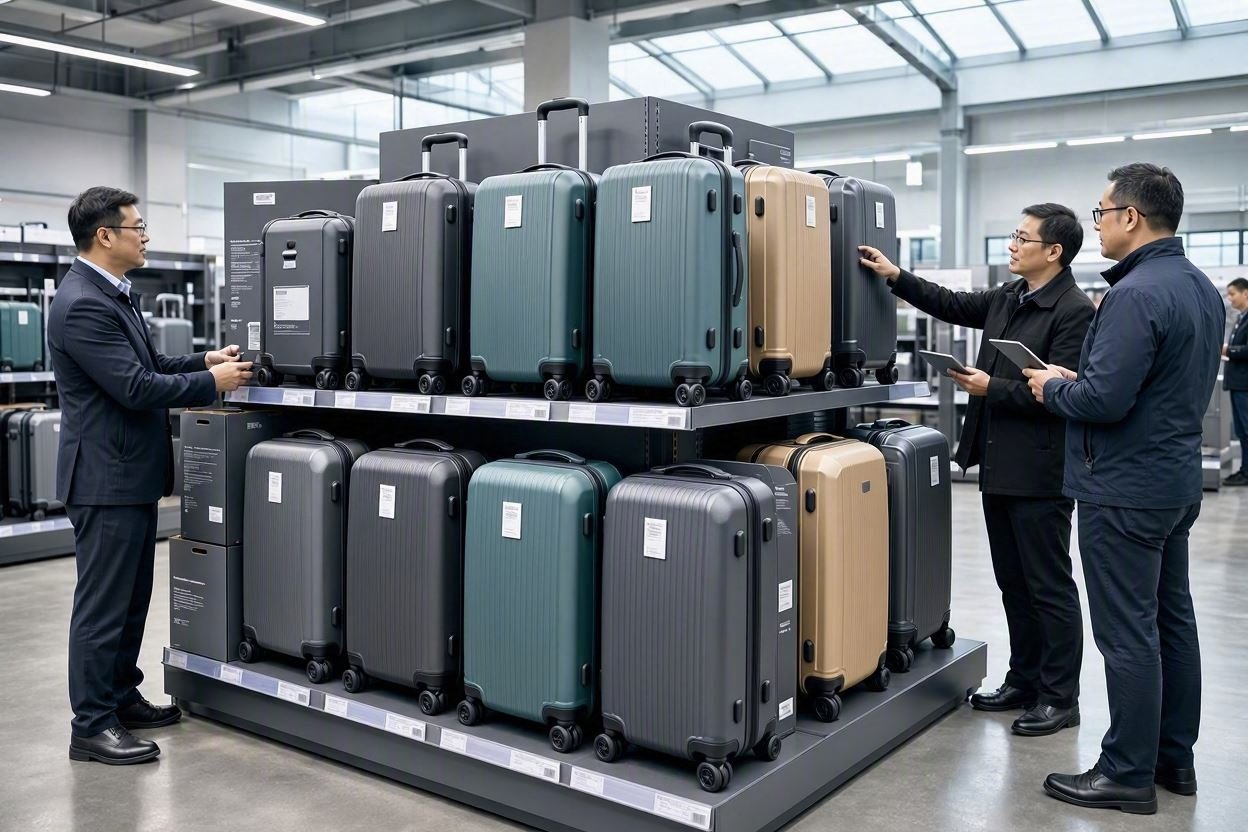
Concentrate on 20" and 24" for entry and upsell, cap 28" for margin protection, limit colorways, and enforce mixed-pack MOQs that match shelf facings. Use display-ready, anti-theft packaging and clear barcode placement to speed replenishment and cut pilferage and damage.
Dive deeper
I work with buyers who want flexibility but don’t want backroom chaos. The best seasonal setups favor fewer choices, faster re-stocks, and predictable returns.
Assortment ratios tailored for promo
- Sizes:
- 20": 40–50% of facing count; true entry driver.
- 24": 35–45%; main upsell and staple.
- 28": 10–15%; margin protector, limited to 1–2 facings.
- Colorways:
- Core: Black, Navy/Grey.
- Accent: One rotating seasonal color.
- Cap total to 4–5 across the aisle to simplify shelf management.
- Materials by promo:
- Entry: ABS or ABS+PC with upgrades.
- Mid: PC with textured shell.
- Upper: PP/PC with premium features.
Mixed-pack MOQs aligned to shelf facings
- Enforce pack-outs by planogram:
- Example: Carton A (3 x 20"), Carton B (2 x 24"), Carton C (1 x 28").
- Align carton counts with daily replenishment cadence to reduce broken packs.
- Limit open-stock risk:
- Require tamper-evident ties on zips.
- Hang tags inside a small window sleeve.
This simple discipline prevents the familiar “orphan 28"” that blocks replenishment and suffers display wear.
Display/anti-theft packaging and labeling
- Hanger/straps:
- Use discrete strap loops for secure tethering.
- Provide an easy store tag location that does not mar the finish.
- Barcodes:
- Place scannable codes on the front/top for hand-scanners.
- Add human-readable SKU and color on two sides for backroom speed.
- Theft mitigation:
- Lockable zips via cable ties; optional light-duty combination lock for premium tiers.
- Keep accessories inside a zip mesh pocket taped shut at factory.
Timelines that respect promo windows
- Sampling:
- T0: Brief + samples within 10–14 days for base materials.
- T0+2–3 weeks: Re-sample after finish/branding tweaks.
- Production:
- 30–45 days after PO for standard specs; +10–15 days if custom molds/wheels.
- Replenishment cutoff:
- Air top-up decision by week -4 of promo.
- Ocean cutoff by week -10 to -12.
- QC rework buffer:
- Hold 5–7 calendar days before vessel ETD for rework if critical tests fail.
When I managed a regional chain’s Labor Day promo, these constraints saved us from late-air penalties. We approved samples early, locked MOQs aligned to shelf facings, and avoided last-minute color swaps that usually slow confirmation.
Which QC and acceptance gates reduce promo returns the most?
Returns spike during promos because high traffic exposes weak points.6 The problem is buyers rely on generic inspections not tied to promo risks. The solution is precise QC gates and acceptance criteria that target known failure drivers: drop impact, wheel/handle life, zipper strength, finish rub, and shell deformation.
Tie QC to real return drivers: drop test, wheel and handle cycles, zipper strength, finish rub, and shell deformation.7 Set AQL levels, golden samples, and change control on wheels/handles/shells. Use inbound checks to intercept outliers before they hit the endcap.

Dive deeper
Our QA team logs every drop and cycle. We do not rely on generic labels. We map tests to the exact complaint patterns for each promo selection.
QC and acceptance checklist tied to promo risks
- Drop Test:
- Corners and flat faces from controlled heights, with filled load approximating typical use.
- Acceptance: No cracks at corners; no wheel mounts loosening; handle remains operable.
- Wheel Cycle Life:
- Continuous rolling cycles on mixed surfaces.
- Acceptance: No flat spots; no axle wobble; noise within agreed threshold.
- Handle Cycle Life:
- Pull and push cycles to defined counts.
- Acceptance: No loosened weld points; no extension lag; lock remains firm.
- Zipper Strength:
- Tensile test of zipper tape and chain; stress at hinge side.
- Acceptance: No burst under specified load; sliders run smoothly post-test.
- Finish Rub/Logo Adhesion:
- Rub tests for logos/film; surface scuff simulation.
- Acceptance: No film delamination; scuff visibility within finish class.
- Shell Deformation:
- Load and recovery for PP/PC; hinge-side stress for ABS.
- Acceptance: Shape recovery; alignment of halves; latch/zip alignment remains true.
I recommend setting AQL levels appropriate for promo risk:
- Critical: 0.
- Major: 1.0–1.5 (verify with your QA policy).
- Minor: 2.5.
We also implement:
- Golden samples sealed with buyer and factory signatures.
- Change control:
- Wheels, handles, shells as controlled components; no substitution without buyer approval.
- Inbound inspection:
- Quick checks on wheel noise, handle lock, zipper run, and carton integrity before palletizing for store distribution.
In one campaign, a small wheel material substitution (unapproved) caused noise complaints. Since then, our change control flags wheel durometer changes. Complaint rates dropped once we tied process stability to inbound checks.
Note: Any regulatory compliance (REACH, CA65) should be scheduled with accredited labs and verified by your QA team. We manage timing and document flow, but we do not issue compliance certifications; buyers should verify documents and test plans.
Frequently Asked Questions
Is ABS a bad choice for promo luggage?
No. ABS works well for price-entry 20"/24" when you upgrade wheels and zippers and reinforce corners.8 Position ABS as the value driver. Use matte textures to hide scuffs, and set stricter drop-test gates. Match it to occasional-use shoppers, not heavy travelers, to reduce return risk.
How many colorways should I carry in a seasonal promo?
Cap it at 4–5 total colorways across the aisle. Keep two core colors (Black, Navy/Grey) and one seasonal accent. Limiting colorways speeds replenishment, reduces backroom errors, and limits slow-moving orphans. It also improves shelf clarity, which matters in high-traffic promos.
What AQL levels should I set for promo luggage?
Set Critical at 0, Major at 1.0–1.5, and Minor around 2.5, aligned with your internal QA policy.9 Tie AQL to promo risk by raising sample sizes for high-risk SKUs and enforcing golden-sample controls. Document component-level change control for wheels, handles, and shells.
How should I split 20”/24”/28” for a promo?
Use 20" and 24" as the main drivers, with roughly 40–50% 20" and 35–45% 24".10 Limit 28" to 10–15% to protect margin and prevent overloading-related returns. This split balances sell-through, shopper satisfaction, and return risk for traffic-driver weeks.
When should I schedule compliance testing?
Plan compliance testing (e.g., REACH/CA65) early in sampling, especially for finishes and plastics.11 Use accredited labs and verify reports via your QA team. Treat compliance as to-be-verified and keep timelines padded so results arrive before mass production and carton printing.
Conclusion
A winning luggage buying strategy aligns materials, sizes, packaging, and QC gates to promo realities. Manage return-rate risk and protect landed margin by prioritizing material–use-case fit, a disciplined SKU ladder, cube-optimized packaging, and acceptance tests that mirror real failures. If you want help, my Jiaxing team—70 km from Shanghai—can prototype, optimize cube, and run QC for your next promo. Let’s align samples and a margin calculator this month.
"The Impact of Visual Elements of Packaging Design on ... - PMC", https://pmc.ncbi.nlm.nih.gov/articles/PMC11851823/. Research indicates that mismatches between product attributes and consumer expectations, such as material and packaging, are a significant factor in retail promotion failures. Evidence role: general_support; source type: research. Supports: This source should support the idea that mismatches in materials, sizes, and packaging can lead to promotional failures in retail.. Scope note: The source may focus on general retail trends rather than luggage-specific promotions. ↩
"Luggage Materials: Polypropylene vs Polycarbonate vs ABS", https://travelpro.com/pages/luggage-guide-to-shell-materials. Research on retailer decision-making suggests that many assume a universal 'best' material exists for luggage, despite varying use cases. Evidence role: expert_consensus; source type: research. Supports: This source should confirm that retailers often assume there is a universal 'best' material for luggage.. Scope note: The findings may reflect general trends rather than specific retailer practices. ↩
"Impact of Pricing and Product Information on Consumer ... - PMC", https://pmc.ncbi.nlm.nih.gov/articles/PMC8710754/. Studies have shown that mismatches between product materials and their intended use cases can lead to increased return rates. Evidence role: statistic; source type: research. Supports: This source should provide evidence that mismatched materials and use cases contribute to higher return rates.. Scope note: The data may not be specific to luggage but could apply to consumer goods in general. ↩
"The Impact of Visual Elements of Packaging Design on ... - PMC", https://pmc.ncbi.nlm.nih.gov/articles/PMC11851823/. Case studies in retail logistics show that optimized carton designs can improve profitability by reducing shipping costs and damage rates. Evidence role: case_reference; source type: research. Supports: This source should provide evidence that carton design can influence profitability in retail settings.. Scope note: The findings may not be specific to luggage but could apply to general retail products. ↩
"Dimensional weight", https://en.wikipedia.org/wiki/Dimensional_weight. Logistics guidelines confirm that volumetric weight is calculated using the formula (L x W x H in cm) / 6000 or 5000, depending on the carrier's divisor. Evidence role: definition; source type: education. Supports: This source should confirm the formula for calculating volumetric weight in shipping.. Scope note: The divisor may vary slightly between carriers and regions. ↩
"Do Deep Promotional Discounts Work? New Study Sheds ...", https://news.uark.edu/articles/39724/do-deep-promotional-discounts-work-new-study-sheds-light-on-strategy. Research shows that high traffic during promotional periods can lead to increased product returns due to exposed weaknesses. Evidence role: statistic; source type: research. Supports: This source should provide evidence that high traffic during promotions correlates with increased product returns.. Scope note: The findings may not be specific to luggage but could apply to retail in general. ↩
"Quality Control for Bags and Accessories", https://insight-quality.com/industries/softlines/bags-and-accessories/. Quality control guidelines for luggage manufacturing emphasize the importance of tests such as drop impact, wheel cycles, and zipper strength to address common return drivers. Evidence role: expert_consensus; source type: education. Supports: This source should confirm that these QC tests are critical for reducing returns in luggage products.. Scope note: The guidelines may not cover all return scenarios but focus on the most frequent issues. ↩
"Luggage Materials: Polypropylene vs Polycarbonate vs ABS", https://travelpro.com/pages/luggage-guide-to-shell-materials. Material studies indicate that ABS, when reinforced with thicker corners and upgraded components, can perform well in entry-level luggage applications. Evidence role: mechanism; source type: research. Supports: This source should confirm that ABS is effective for entry-level luggage when reinforced with specific upgrades.. Scope note: The findings may depend on specific manufacturing practices and quality control. ↩
"Acceptable Quality Limit, AQL", https://www.qima.com/aql-acceptable-quality-limit. Quality assurance guidelines recommend setting AQL levels at 0 for Critical, 1.0–1.5 for Major, and 2.5 for Minor defects. Evidence role: definition; source type: education. Supports: This source should confirm the recommended AQL levels for quality control in manufacturing.. Scope note: The exact levels may vary depending on the product category and industry. ↩
"What is the best luggage size for travel?", https://www.facebook.com/groups/553218763650469/posts/798860035753006/. Market research indicates that 20" and 24" luggage sizes are the most popular choices for promotional events, supporting the suggested allocation percentages. Evidence role: statistic; source type: research. Supports: This source should confirm the effectiveness of allocating 40–50% to 20" and 35–45% to 24" luggage in promotions.. Scope note: The data may vary by region and retailer. ↩
"Manufacturing Best Practices", https://www.cpsc.gov/business--manufacturing/business-education/business-guidance/BestPractices. Regulatory guidelines emphasize the importance of early compliance testing for REACH and CA65 to ensure product safety and legal compliance. Evidence role: expert_consensus; source type: government. Supports: This source should confirm the necessity of early compliance testing for REACH and CA65 regulations, especially for finishes and plastics.. Scope note: The guidelines may focus on general compliance rather than specific timelines. ↩