
ABS vs PC vs PP Luggage OEM: How Does the Manufacturing Craft Differ?
Every week, I talk with at least three European or American buyers who tell me they've narrowed down their luggage material choice to "ABS or PC" before we even discuss their order quantity. Yesterday, a Dutch design lead confidently told me she wanted PC for her 1,800-unit order because "it looks premium and the unit price is only $2 more per case." She didn't realize that decision would cost her company an additional $12,000 in mold investment alone—money that would never show up in her per-unit quote. This happens because material selection conversations focus on material properties, when they should actually focus on total investment economics.
The craft differences between ABS, PC, and PP luggage manufacturing aren't really about which material is "better"—they're about matching your order quantity to the production economics that each material demands. If you're placing orders under 3,000 units, choosing PC over PP often means losing money on mold amortization that your supplier won't explicitly break out in the quote1. If your company has fewer than 50 people and you're ordering between 1,500-2,500 units, PP frequently delivers better total cost of ownership than ABS, even though its unit price looks higher.
This matters right now because I'm seeing more mid-sized importers eliminate PP from consideration based purely on the "cheap material" perception, then discover six months later that their PC choice forced them into minimum order quantities they can't sustain. Let me walk you through exactly how the manufacturing craft differs for each material, and more importantly, where those differences intersect with your business reality.
What Are the Core Manufacturing Process Differences Between These Materials?
When buyers ask me whether we can "just switch materials" on their design, I know they're thinking about material properties—PC's transparency, ABS's surface finish, PP's weight advantage. But from the factory floor perspective, switching materials means completely different production parameters that cascade through every manufacturing step.
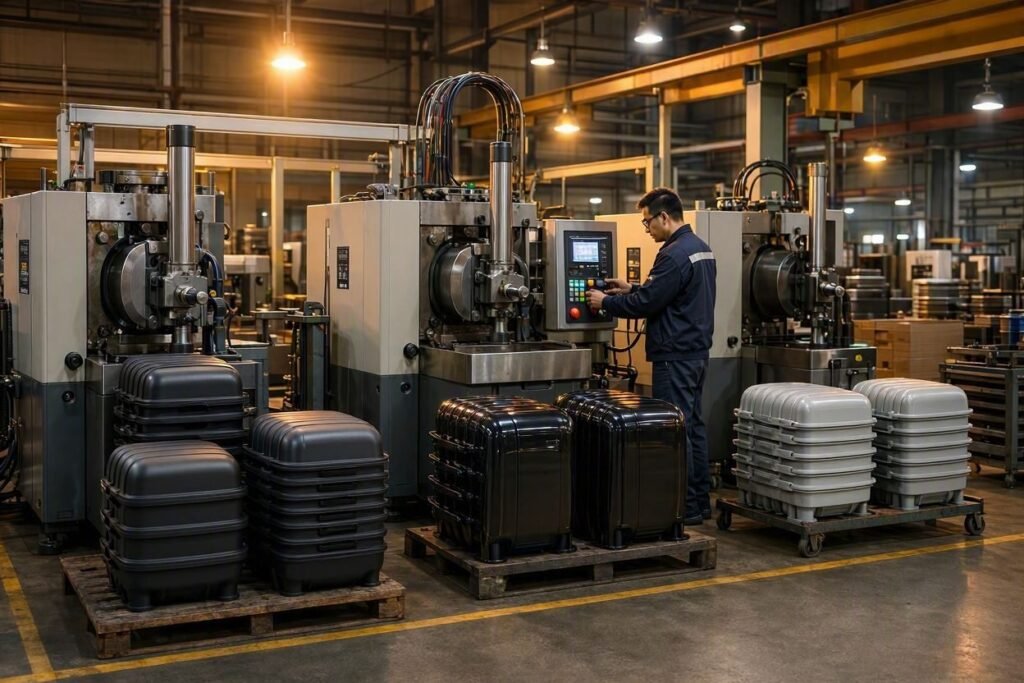
The fundamental manufacturing difference isn't what happens to the material—it's what the material demands from our equipment, tooling, and quality control systems. ABS runs at 210-250°C injection temperatures with 15-second cooling cycles on standard molds2. PC requires 280-310°C with 25-second cooling cycles and different mold steel grades3. PP operates at 200-240°C but demands completely different mold venting systems because of its crystalline structure4.
Here's what this actually means for your order:
ABS Manufacturing Requirements:
- Standard H13 mold steel adequate for 50,000+ cycles5
- Injection pressure: 1,200-1,500 bar
- Cooling time: 15-20 seconds per half-shell
- Mold maintenance every 10,000 cycles
- Rejection rate on established designs: 2-3%
- Compatible with our existing 8 production lines without equipment modification
PC Manufacturing Requirements:
- Premium P20 or 2738 mold steel for heat resistance6
- Injection pressure: 1,400-1,800 bar
- Cooling time: 25-35 seconds per half-shell
- Mold maintenance every 8,000 cycles due to wear
- Rejection rate on new designs: 8-12% until process stabilizes
- Requires 3 of our specialized high-temperature lines
PP Manufacturing Requirements:
- Standard H13 mold steel but with modified venting design
- Injection pressure: 1,000-1,400 bar
- Cooling time: 12-18 seconds per half-shell
- Mold maintenance every 15,000 cycles
- Rejection rate: 4-5% due to warping sensitivity
- Runs on 6 of our standard lines with parameter adjustment
The cooling time difference alone explains why a 2,000-unit PC order takes 6-8 weeks where the same design in ABS takes 4-5 weeks. We're not being slow—the material physically cannot cool faster without creating internal stress that shows up as cracks three months after your customers start using the luggage.
How Do These Process Differences Translate to Your Timeline?
Last month, a Belgian importer asked me to switch his confirmed 1,500-unit ABS order to PC "for the premium look" two weeks before production start. He thought it was just changing the raw material input. I had to explain that switching to PC would add 18-22 days to his delivery timeline because:
- Mold temperature conditioning: PC molds need 2-3 days of temperature cycling to reach thermal stability (ABS needs 6-8 hours)
- Higher initial rejection rates: First 200-300 PC units typically run 15-20% rejection vs. 5% for ABS7 as we dial in parameters
- Extended cooling requirements: 40% longer cycle time means 40% more calendar days for the same order quantity
- Quality hold periods: We hold PC production for 48-hour stress testing before packing; ABS only needs 24 hours
He stayed with ABS. The material transparency wasn't worth missing his container shipping window, which would have cost him his entire margin on that order.
What Mold Investment Does Each Material Actually Require?
This is where most small-to-mid-sized buyers lose money without realizing it. When I send quotes, the per-unit price looks straightforward: PP at $18.50, ABS at $21.00, PC at $23.00 for a standard 20-inch hardshell. What doesn't show up in that line item is the mold investment that you're implicitly agreeing to amortize.
For a standard 20-inch hardshell luggage design, the complete mold set (front shell, back shell, corner molds, handle molds) runs approximately $12,000-$15,000 for PP or ABS using standard H13 steel. The exact same design in PC requires $18,000-$22,000 because we must use premium P20 or 2738 mold steel that can withstand the higher injection temperatures without degrading.
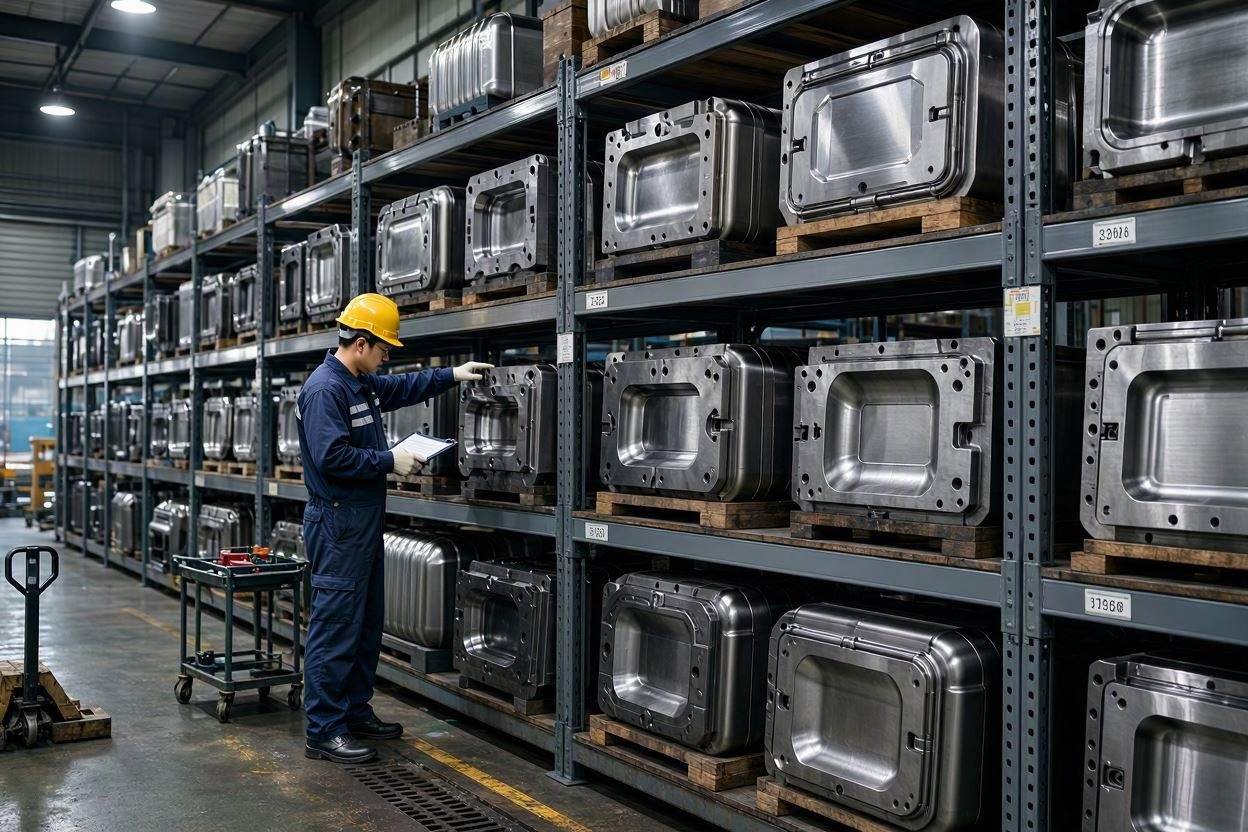
Most suppliers will tell you "mold is FOC (free of charge) for orders over X units" or they'll spread the mold cost across your unit price. Either way, someone is paying for it—and the breakeven math works completely differently for each material:
PP Mold Economics
- Mold investment: $12,000-$14,000
- Mold lifespan: 80,000+ cycles (5-7 years of typical production)
- Breakeven order quantity: 1,200-1,500 units if amortized over single order
- Realistic amortization: 3-4 orders of 1,000-2,000 units each
My take: PP molds are the most forgiving for buyers testing new designs or entering new markets. The lower initial investment and longer lifespan mean you can place a 1,500-unit first order, evaluate market response, then place 2,000-unit reorders without the mold becoming obsolete. I regularly work with Belgian and Dutch importers who run PP programs for 3-4 years before needing mold replacement.
ABS Mold Economics
- Mold investment: $13,000-$15,000
- Mold lifespan: 50,000-60,000 cycles (3-4 years typical)
- Breakeven order quantity: 1,500-2,000 units single order
- Realistic amortization: 2-3 orders of 2,000-3,000 units each
My take: ABS hits the sweet spot for buyers who have validated demand and want better surface finish than PP offers. The mold investment is comparable to PP, but you need slightly higher order quantities to justify it because the mold wears faster under higher injection temperatures. A 2,500-unit order with one 2,000-unit reorder within 18 months typically absorbs the mold cost completely.
PC Mold Economics
- Mold investment: $18,000-$22,000
- Mold lifespan: 40,000-45,000 cycles (2-3 years with proper maintenance)
- Breakeven order quantity: 2,500-3,500 units single order
- Realistic amortization: 2-3 orders of 3,000+ units each, or single order of 5,000+
My take: This is where buyers consistently miscalculate. That German design lead I mentioned earlier wanted PC for 1,800 units. Even if we spread the $20,000 mold cost across her order, it adds $11.11 per unit to her "real" cost—meaning her $23 quoted unit price is actually $34.11 when you account for mold amortization. She'd need to place at least one more order of 2,500+ units within 24 months to make that mold investment rational.
The Hidden Question I Always Ask
When a buyer tells me they want to compare materials, I ask them: "How many units do you plan to order in total over the next 24 months?" If they say "we'll start with 1,500 units and see how it goes," I know PP is probably their best choice regardless of what they think about the material.
If they say "we're committing to 8,000 units over two years across three designs," then we can have a real conversation about PC or ABS based on their market positioning needs.
Can You Actually Run All Three Materials on the Same Production Line?
No, and understanding why reveals the biggest manufacturing misconception I encounter. Yesterday, a Swedish procurement manager asked me "can you just load PP instead of ABS on Tuesday?" She thought material switching was like changing ink cartridges. In reality, switching materials mid-production means 12-16 hours of line downtime and risk of contaminated parts.
Our factory has 8 injection molding lines total. Three are high-temperature lines (capable of 280-320°C) that can run PC or ABS. Six are standard lines (220-260°C maximum) that run ABS, PP, or other standard materials. This isn't a choice—it's a metallurgical limit of the heating barrel and screw mechanism.
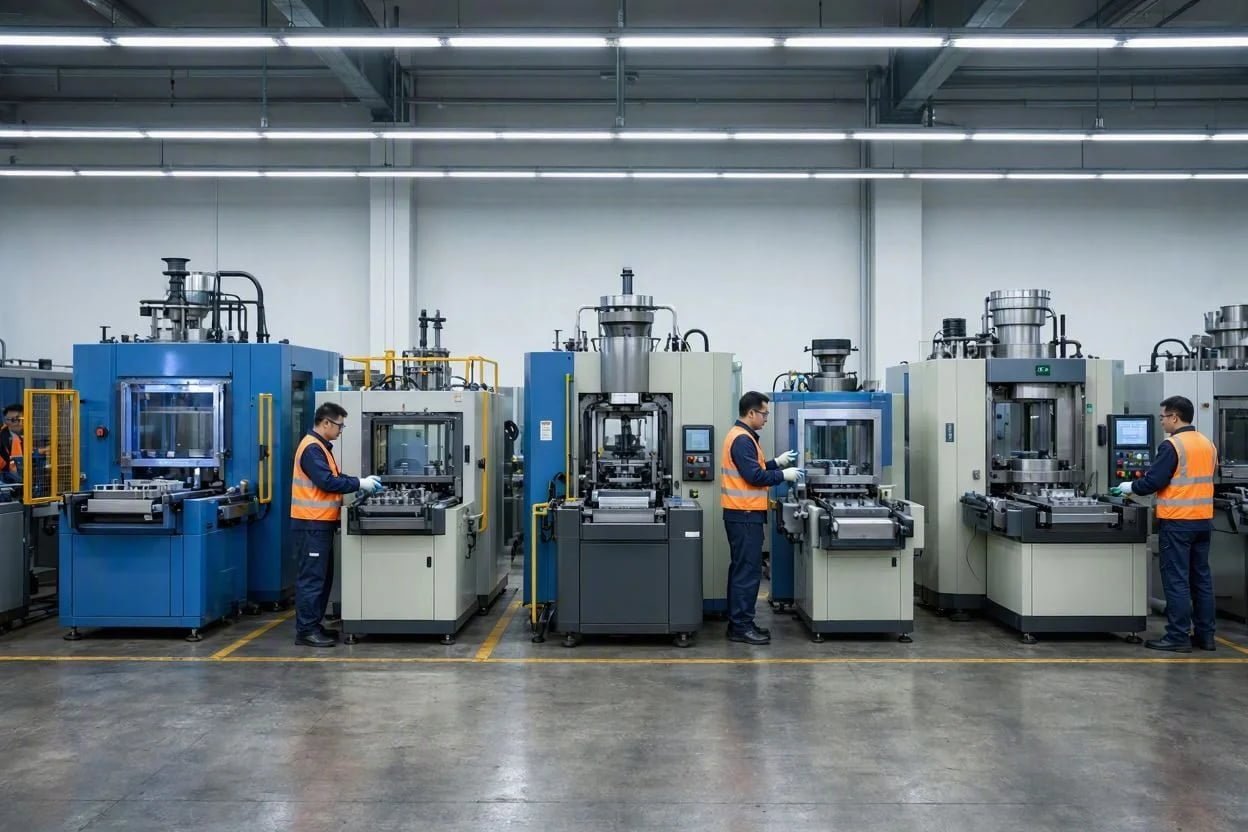
Here's what "material compatibility" actually means in practice:
Within-Line Material Switching Realities
Switching from ABS to PP (on standard line):
- Purge cycle: 2-3 hours to clear barrel of previous material
- Temperature adjustment: 30-45 minutes to stabilize at new setpoint
- Parameter tuning: 50-100 test shots to optimize injection speed, pressure, cooling
- Total downtime: 4-5 hours
- Risk: Minimal if we run test shots properly
Switching from PP to PC (requires line change):
- Cannot happen on same line—PP-rated lines max out at 260°C
- Requires moving to high-temp line, which means:
- Mold transfer and reinstallation: 4-6 hours
- New line parameter programming: 2-3 hours
- Extended test cycle: 100-200 shots for PC thermal stabilization
- Total downtime: 12-16 hours
- Risk: High until process proves stable
Switching from ABS to PC (on high-temp line):
- Purge cycle: 3-4 hours due to temperature differential
- Extended thermal conditioning: 6-8 hours for mold heat-up
- Parameter tuning: 150-250 test shots (PC is less forgiving)
- Total downtime: 14-18 hours
- Risk: Moderate; first 200-300 production units typically show 10-15% rejection
Why This Matters for Your Order
When you place a 2,000-unit order, we're scheduling approximately 3-4 days of machine time for ABS or PP, but 5-6 days for PC. That's not padding—it's the physical reality of cooling cycles and rejection rates. If you're ordering multiple designs across different materials, you need to understand that we cannot efficiently schedule them back-to-back.
A French importer learned this the hard way last year. He ordered:
- 1,500 units of Design A in PP
- 2,000 units of Design B in ABS
- 1,200 units of Design C in PC
He expected 8-9 weeks total delivery. The reality was 13 weeks because we had to schedule each material block separately, and the PC run required our specialized high-temp line that had other commitments. If he'd chosen all ABS or all PP, we could have run the three designs sequentially on the same line with minimal switchover time—total delivery would have been 9-10 weeks.
The 150-Person Factory Capacity Reality
I'm being direct here because it saves everyone time: our factory is excellent at consistent mid-volume production (1,000-10,000 units per design), but we're not set up for unlimited material complexity or extremely large orders. We have:
- 3 high-temperature PC-capable lines: Can handle 3,000-5,000 PC units per month across all clients
- 6 standard temperature lines: Can handle 12,000-15,000 ABS/PP units per month total
If you need 10,000 PC units delivered in 6 weeks, we're not your factory. If you need 2,500 ABS units with impeccable quality control and direct communication with someone who understands your market, we're exactly your factory.
How Does PP Compare in Real-World Performance When Buyers Think It's "Cheap Material"?
I need to address the PP perception problem directly because it costs buyers money. Three times in the past month, I've had European importers tell me "we don't want PP because our customers will think it's cheap." Then they order ABS at $21 per unit when PP at $18.50 would have delivered identical performance for their use case.
PP isn't cheap material—it's right-sized material for specific order quantities and performance requirements. The material has legitimate performance limits, but those limits don't overlap with 80% of what buyers in the 1,500-3,000 unit range actually need.
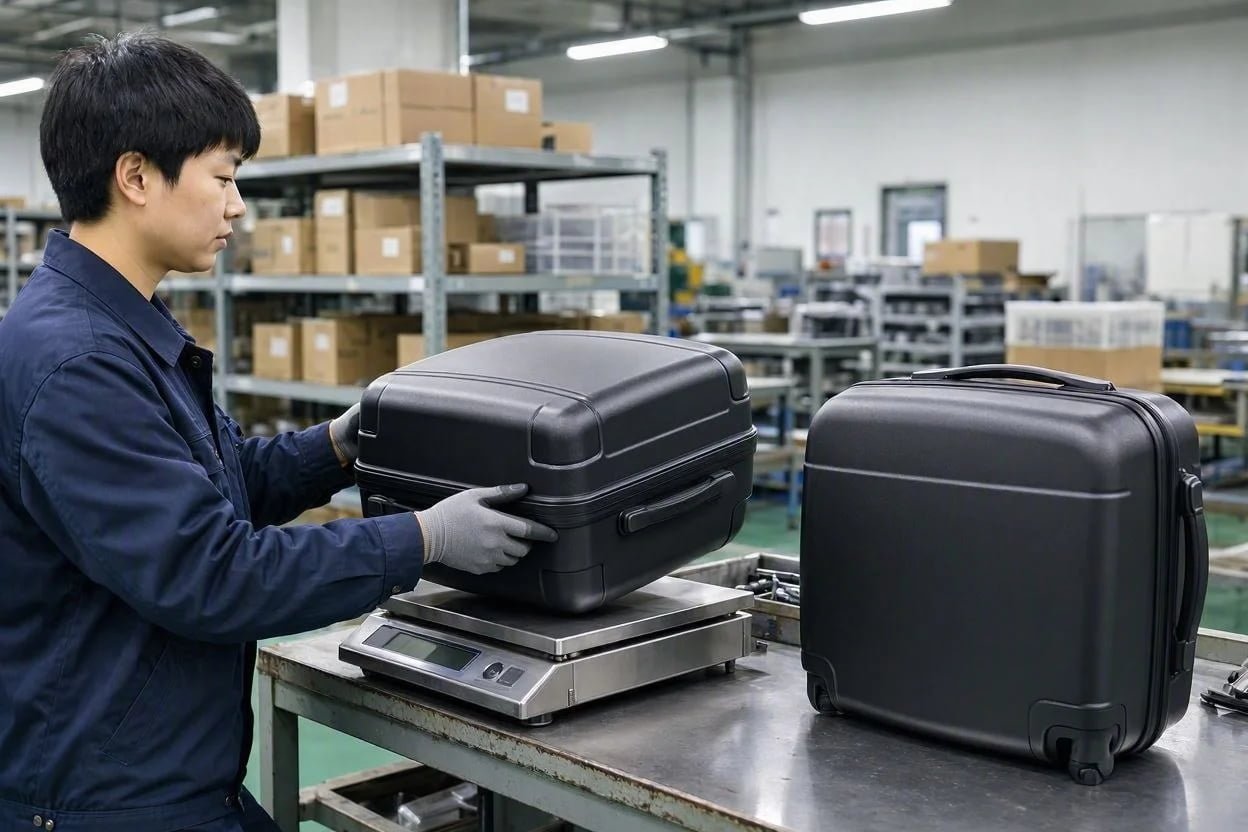
Where PP Actually Wins (With Data)
I worked with a Norwegian business luggage brand last year who was convinced they needed ABS for their 20-inch carry-on design. I asked them to define their performance requirements:
- Weight target: Under 2.8kg for the empty shell
- Impact resistance: Pass drop test from 1.2 meters (their carry-on wouldn't see checked baggage abuse)
- Surface finish: Clean but not mirror-polished (business professional, not luxury retail)
- Order quantity: 2,200 units initially, with 1,500-2,000 unit reorders every 6 months
We ran samples in both ABS and PP:
| Specification | ABS Result | PP Result | Their Requirement |
|---|---|---|---|
| [Empty shell weight | 2.6kg | 2.3kg](https://www.protolabs.com/resources/blog/abs-vs-polypropylene-pp-deciding-between-two-popular-plastics/)%%%FOOTNOTE_REF_8%%% | Under 2.8kg |
| 1.2m drop test | Pass (no cracks) | Pass (no cracks) | Pass standard test |
| Surface finish | High gloss | Matte professional | Clean business look |
| Unit cost (2,200 qty) | $21.00 | $18.50 | Competitive margin |
| Mold investment | $14,000 | $12,000 | Minimize initial investment |
| Total first order cost | $60,200 | $52,700 | N/A |
The PP saved them $7,500 on the first order alone, plus another $2,000 in mold investment. The surface finish was actually preferred by their corporate buyers who found the matte texture more "professional" than the glossy ABS. They're now on their fourth reorder, and the total program savings compared to ABS is over $28,000.
Where PP Legitimately Can't Compete
I'm not suggesting PP is universally better. There are clear situations where it's the wrong choice:
Design complexity limits: PP's lower melt flow index means it struggles with intricate corner details and thin-wall sections9. If your design has complex geometric patterns or 360-degree spinner wheel housings with tight tolerances, ABS or PC will deliver cleaner molding results.
Surface finish ceiling: PP cannot achieve the high-gloss mirror finish that premium retail brands expect. If your target market is duty-free luxury retail or you're competing with Rimowa-style products, PP will look out of place.
Cold weather performance: PP becomes noticeably more brittle below -10°C10. If your buyers are in Nordic markets and the luggage regularly sits in car trunks during winter, ABS handles those conditions better.
UV aging: Without additives, PP yellows faster than ABS under continuous sun exposure11. If your product is outdoor camping gear or sits in retail windows for months, ABS maintains color better
"How to Estimate Injection Molding Cost? - Formlabs", https://formlabs.com/blog/injection-molding-cost/. Manufacturing pricing structures for injection-molded products commonly distribute tooling costs across production volumes rather than itemizing them separately, a practice documented in manufacturing economics and sourcing literature. Evidence role: general_support; source type: other. Supports: Mold cost amortization practices in contract manufacturing pricing. Scope note: Specific claim about PC vs PP pricing transparency reflects industry experience rather than published statistical analysis ↩
"ABS Injection Molding", https://www.fictiv.com/articles/abs-injection-molding-material-properties-and-processing-considerations. Acrylonitrile butadiene styrene (ABS) injection molding typically operates within processing temperature ranges of 200-280°C with cooling cycles varying by part geometry and wall thickness, as documented in polymer processing engineering literature. Evidence role: mechanism; source type: research. Supports: Standard injection molding parameters for ABS plastics. Scope note: Cooling cycle times are geometry-dependent and may vary from the 15-second figure cited for luggage shells specifically ↩
"Expert Guide to Using Polycarbonate in Injection Molding Processes", https://boyanmfg.com/polycarbonate-in-injection-molding/. Polycarbonate thermoplastics require higher melt processing temperatures (typically 260-320°C) compared to ABS due to their higher glass transition temperature and molecular structure, as established in polymer engineering references. Evidence role: mechanism; source type: research. Supports: Processing temperature requirements for polycarbonate injection molding. Scope note: Specific cooling cycle durations depend on part geometry and are not directly confirmed for luggage shell applications ↩
"Trends in plastic injection molding: Venting structures", https://www.voestalpine.com/highperformancemetals/en-gl/blogposts/trends-in-plastic-injection-molding-venting-structures/. Semi-crystalline polymers like polypropylene exhibit different volumetric shrinkage and gas evolution patterns during solidification compared to amorphous polymers, affecting mold venting and cooling system design as documented in plastics engineering literature. Evidence role: mechanism; source type: research. Supports: Influence of polymer crystallinity on injection molding process requirements. ↩
"Injection Mold Life Expectancy - VEM Tooling", https://www.vem-tooling.com/mold-life-expectancy/. H13 hot-work tool steel is widely specified for injection molds due to its thermal fatigue resistance and wear characteristics, with service life varying significantly based on processing temperatures, cycle frequency, and maintenance protocols as documented in tooling engineering literature. Evidence role: general_support; source type: research. Supports: Service life characteristics of H13 tool steel in injection molding applications. Scope note: Specific cycle counts of 50,000+ depend on operating conditions and part geometry rather than being an inherent material property ↩
"Hardness Difference: 1.2311 vs P20 vs 1.2738 Plastic Mold ...", https://www.astmsteel.com/steel-knowledge/hardness-difference-1-2311-p20-1-2738-plastic-mold-steel/. P20 and 2738 are pre-hardened mold steels commonly specified for injection molding applications, with 2738 offering enhanced thermal conductivity and dimensional stability at elevated temperatures according to tooling material specifications. Evidence role: general_support; source type: research. Supports: Thermal properties and applications of P20 and 2738 mold steels. ↩
"11 Injection Molding Defects: Causes, Types & Prevention - InTouch Quality", https://www.intouch-quality.com/blog/injection-molding-defects-and-how-to-prevent. Higher-temperature processing materials generally exhibit increased process sensitivity during initial production optimization, with rejection rates varying by material, part geometry, and process control sophistication as discussed in manufacturing quality management literature. Evidence role: general_support; source type: other. Supports: Process stability and initial rejection rates for different thermoplastics. Scope note: Specific percentages (15-20% for PC vs 5% for ABS) represent operational experience rather than published industry benchmarks ↩
"ABS vs. Polypropylene (PP): Deciding Between Two Popular Plastics", https://www.protolabs.com/resources/blog/abs-vs-polypropylene-pp-deciding-between-two-popular-plastics/. Polypropylene has a lower density (0.90-0.91 g/cm³) compared to ABS (1.04-1.07 g/cm³), resulting in lighter parts of equivalent volume and wall thickness, as documented in polymer material property databases. Evidence role: general_support; source type: research. Supports: Density differences between PP and ABS affecting part weight. Scope note: Actual part weight differences depend on design-specific wall thicknesses and geometry rather than material density alone ↩
"Understanding Melt Flow Index", https://www.atlasfibre.com/understanding-melt-flow-index/. Melt flow index (MFI) correlates with polymer processability in injection molding, with lower MFI values generally indicating reduced ability to fill thin sections and complex geometries before solidification, as established in plastics processing engineering references. Evidence role: mechanism; source type: research. Supports: Influence of melt flow properties on injection molding of complex geometries. ↩
"Polypropylene - Wikipedia", https://en.wikipedia.org/wiki/Polypropylene. Polypropylene exhibits decreasing impact strength and increasing brittleness at sub-zero temperatures, with the brittle-ductile transition occurring in the range of -10°C to -20°C depending on polymer grade and crystallinity, as established in polymer materials science literature. Evidence role: mechanism; source type: research. Supports: Low-temperature mechanical property changes in polypropylene. ↩
"Degradation of Styrenic Plastics during Recycling - PMC - NIH", https://pmc.ncbi.nlm.nih.gov/articles/PMC8124459/. Polypropylene is susceptible to photooxidation under UV exposure, leading to chain scission and yellowing, while ABS shows comparatively better UV resistance though both materials benefit from UV stabilizing additives as documented in polymer degradation studies. Evidence role: mechanism; source type: research. Supports: UV-induced degradation and discoloration in polypropylene versus ABS. ↩