
Which Luggage Industrial Zone Should You Source From—Guangdong, Zhejiang, or Hebei?
Choosing where to source your luggage is not a simple price comparison. Over years of managing sourcing negotiations across China's three major luggage hubs1, I've watched importers and brand buyers make the same mistake: they rank zones by headline cost, sign with the "cheapest" supplier, and then face hidden trade-offs that cost far more than they saved. The real decision depends on which production constraints matter most to your business model—and each zone hides costly surprises that buyers systematically misunderstand.
Sourcing luggage from the right industrial zone means matching your business constraints—cost floor, design velocity, and capacity scale—to the zone whose strengths align with your priorities. Guangdong excels at integrated, predictable delivery for mid-to-large orders; Zhejiang specializes in rapid design iteration and small-batch customization at premium pricing; Hebei undercuts both on unit cost but requires tolerance for quality variance and extended lead times. The zone that is "best" depends entirely on which variables your margin and timeline can absorb.
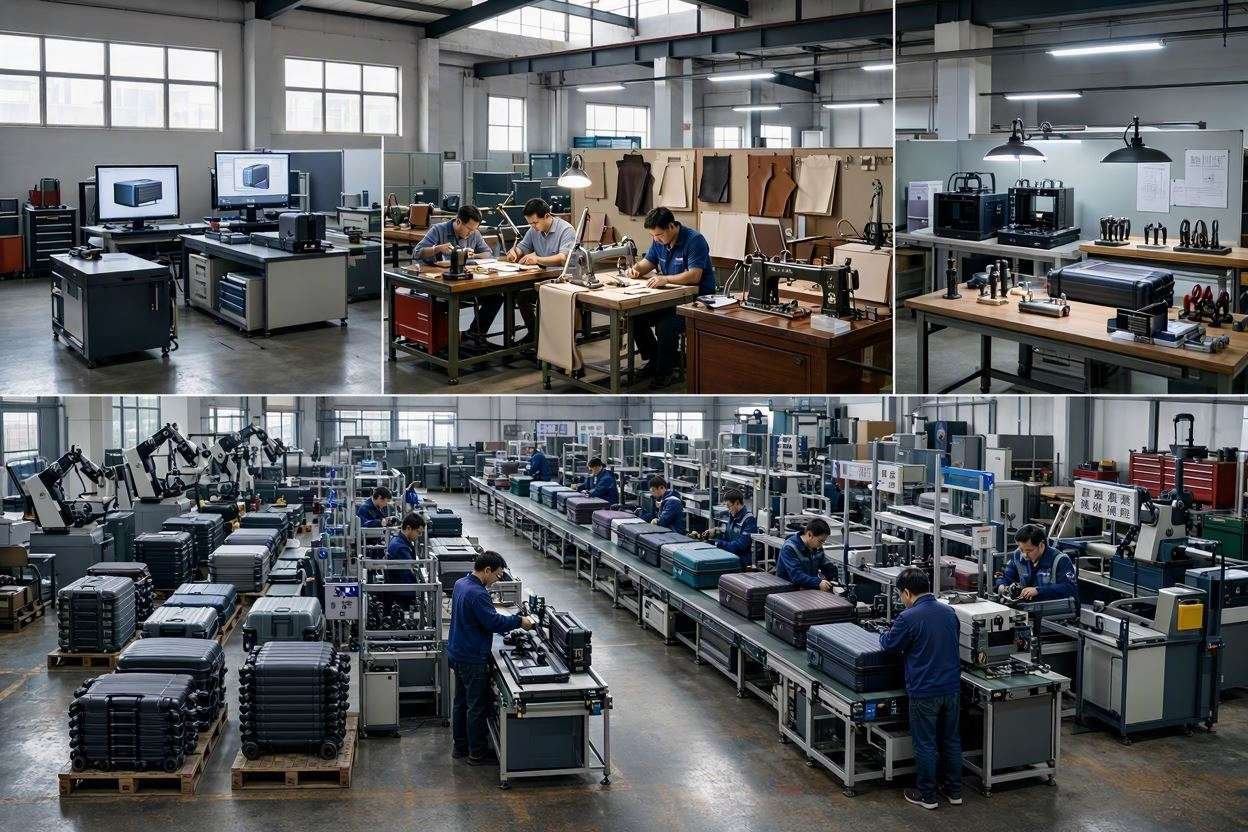
Most importers approach this decision backwards. They ask "Which zone is cheapest?" or "Which zone has the best quality?" and expect a straightforward answer. The problem is that cost, quality, design speed, and reliability are not independent. A Hebei factory's lower per-unit price reflects real labor-cost advantages—but also reflects a fragmented supply chain, less design infrastructure, and higher quality variance. Guangdong's premium reflects integrated suppliers, faster material sourcing, and skilled workforce stability, not just wage inflation. Zhejiang's reputation for design innovation masks a specific business model: they charge steep premiums because they commit heavy upfront tooling spend before knowing if an order scales. Understanding these trade-offs is the real skill of smart sourcing.
In this article, I'll walk you through the hidden decision axes—not the myths about price or quality, but the actual constraints that determine which zone delivers real value for your business model.
What Makes Each Zone Different—Beyond the Price Tag?
The three zones have genuinely different business structures. This is not marketing hype; it reflects decades of regional specialization and supply-chain clustering. But most sourcing guides skip this detail and jump to "Hebei is cheap, Guangdong is premium, Zhejiang is trendy." That narrative obscures the structural reasons why costs and capabilities differ—and obscures which zone actually fits your constraints.
Each luggage industrial zone has a different supply-chain structure, cost base, and design philosophy. Guangdong integrates material suppliers and finishing services locally; Zhejiang optimizes for small-batch tooling and design; Hebei prioritizes labor cost and commodity production. These differences generate real cost gaps and lead-time variance—but they also explain why the cheapest option is rarely the cheapest when you factor in rework, delays, and customization friction.
How Guangdong Built an Integrated Ecosystem
Guangdong is the oldest and largest luggage cluster in China2. Factories there—particularly in zones around Shenzhen and Foshan—grew up in an environment where ABS, PC, and specialty material suppliers existed nearby3, fastener vendors were walking distance, coating and finishing shops operated on-demand, and experienced workers cycled between competing factories. This ecosystem developed over 30+ years and created a specific advantage: vertically-integrated problem-solving.
When a Guangdong factory encounters a material shortage or needs a custom fastener sourced on short notice, they have vendor relationships and backup suppliers already vetted. When a sample fails QC, they have local finishing shops they can pressure into overnight turnarounds. When an order scales unexpectedly, they can tap capacity from allied factories or subcontractors they've worked with for years. This ecosystem advantage is invisible in a per-unit quote, but it shows up in lead time reliability and ability to absorb production shocks.
I've seen importers negotiate with a Guangdong factory and receive a quote with a 8-week lead time. They then negotiate with a Hebei factory and receive a 6-week quote for 15% lower cost. They pick Hebei to save money and accelerate delivery. Then, at week 5, the Hebei factory messages that material sourcing is delayed, and the order will ship at week 9. Meanwhile, the Guangdong factory ships on week 8 as promised because they had backup material suppliers already lined up. The time loss alone—or the scramble to expedite air freight—erases the cost saving and creates margin pressure downstream.
This is not because Hebei factories are incompetent. It is because their supply chain is fragmented. Smaller material vendors, fewer backup suppliers, and less integrated finishing capacity mean each problem requires solving from scratch. Hebei factories are perfectly capable of delivering quality luggage, but they do it on a longer and less predictable timeline when material complexity rises.
Zhejiang's Design Infrastructure and the MOQ Trap
Zhejiang built its reputation on design innovation and rapid tooling4. Factories there employ more industrial designers, invest in faster CAD-to-prototype workflows, and pride themselves on handling complex, custom designs for small-to-medium orders. Brand buyers and importers drawn to "designed in China" sourcing often target Zhejiang first.
Here is where the trap opens. A buyer assumes that "design strength" means "flexible on small orders at standard pricing." It does not. The Zhejiang business model is actually: charge premium pricing because we will invest heavily in tooling and design before knowing if your order will repeat. This is rational economics for the factory, but it creates a mismatch with buyer expectations.
I've facilitated sourcing conversations where an importer asks a Zhejiang factory for 500 units of a custom-design roller bag with a specific handle mechanism. The factory quotes ¥120/unit including tooling amortization. The importer then asks a Guangdong factory for the same 500 units and receives ¥95/unit. The importer assumes Zhejiang is 25% overpriced. What is actually happening is: Zhejiang is front-loading design and tooling cost into the first 500 units because they expect the design to have repeat value; Guangdong is using a simpler design-modification approach that requires less upfront investment per order. If the importer places a second order of 500 identical units, Zhejiang may drop to ¥110/unit (amortizing tooling across two batches) while Guangdong stays near ¥95/unit. If the importer's design complexity increases further, Zhejiang can adapt faster with their design infrastructure, while Guangdong may require more engineering coordination.
The real question is not "Which factory is cheaper?" but "Does my product roadmap justify paying for upfront design investment?" If you are a brand buyer placing large, repeat orders with evolving designs each season, Zhejiang is worth the premium. If you are an importer buying relatively standard luggage in consistent specs, Guangdong delivers better total cost over repeat orders.
Hebei's Cost Floor and the Quality-Rework Trade-off
Hebei is the cost leader for commodity luggage5. Factories there benefit from lower labor costs, lower land costs, and a business model optimized for high-volume, standardized production. For buyers focused on hitting a strict per-unit cost floor, Hebei is genuinely the answer.
But here is what "lower cost" actually means in practice. Hebei factories operate on tighter margins, which means less margin for error6. They employ less experienced quality staff because they cannot afford to pay Guangdong-level wages. They have less redundancy in material sourcing, so they source lower-cost alternatives that may be more sensitive to specification variance. They move faster to hit volume targets, which can mean less meticulous process control on the factory floor.
The net result is not that Hebei quality is "bad." It is that quality variance is higher. You might receive 90% of an order that is flawless, and 10% that requires rework or replacement. In my experience with importers, this 5–10% quality variance is common from Hebei factories when compared to Guangdong or Zhejiang baselines7. If you've quoted margin that assumes 98%+ first-pass quality, the 8% rework rate will consume your profit. If you've built a 15% margin buffer (anticipating some variance), Hebei cost savings make economic sense.
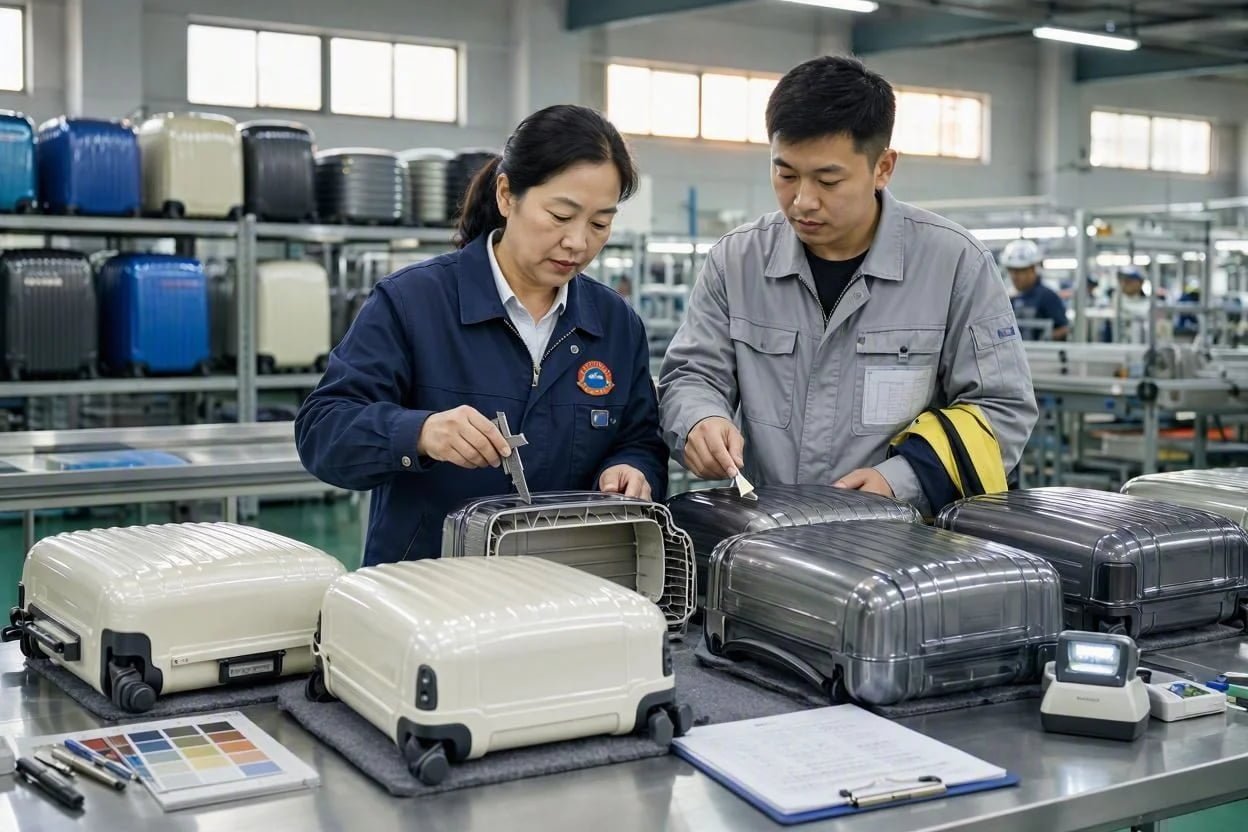
The hidden cost-quality trade-off is not visible in the headline quote. It emerges during production and shipping. This is why smart importers do not simply compare per-unit prices; they estimate total landed cost inclusive of expected rework, expedited QC, or acceptance of defect rates. A Hebei factory might quote ¥80/unit with 95% first-pass quality. A Guangdong factory might quote ¥95/unit with 99% first-pass quality. If your margins are 40%, that 4% quality gap costs you ¥3.20–¥3.80 per unit in rework or write-off. The per-unit price savings is only ¥15, so the net benefit narrows to ¥11–¥12/unit. Once you factor in potential lead-time delays in Hebei (adding inventory carrying costs or air-freight premiums), the advantage may vanish entirely.
The "Time-Cost-Design" Triangle: Why You Cannot Optimize for All Three
The core sourcing decision is not really about which zone is "best." It is about understanding a constraint triangle: you can usually optimize for two of three variables—lowest unit cost, fastest delivery, highest design flexibility—but rarely all three8. Understanding this helps you self-identify which zone actually matches your business model.
Sourcing constraints operate as a trade-off triangle. You can achieve lowest unit cost and fast delivery (Guangdong for commodity specs), or fast delivery and design flexibility (Zhejiang), or lowest cost and design flexibility (Hebei with patience). Attempting to optimize all three—lowest cost, fastest lead time, and complex custom design—requires accepting visible trade-offs in at least one dimension.
Scenario 1: You Prioritize Cost and Volume
If your business model is high-volume, standardized luggage with tight per-unit cost targets, Hebei is the logical choice. You accept longer and less predictable lead times, and you build quality-variance buffers into your margin expectations.
In my experience, importers in this scenario are typically large retailers or discount chains buying commodity luggage in bulk. They have negotiating power, they can tolerate 8–10 week lead times, and a 5–8% quality variance is baked into their expectations. Hebei factories deliver well in this context because the buyer's constraints align with the factory's business model.
What fails is when a buyer wants Hebei cost savings but also wants fast delivery or complex customization. They approach a Hebei factory asking for ¥80/unit, 6-week lead time, and a custom locking mechanism on 1,000 units. The factory quotes ¥95/unit or extends the lead time to 10 weeks, because those constraints shift the economics. The buyer feels misled and blames the factory for being inflexible, when the real issue is that the buyer's constraints are misaligned with the zone's strengths.
Scenario 2: You Prioritize Design Velocity and Brand Differentiation
If your business model is premium or semi-premium luggage with seasonal design updates and the ability to command margin for differentiation, Zhejiang is optimal. You accept that per-unit cost will be higher (because upfront design investment is amortized into each order), but you gain the ability to iterate rapidly on designs and place relatively small repeat orders.
Zhejiang factories invest in design infrastructure and tooling capacity specifically to serve importers and brand buyers who view design as a profit driver, not a cost center. They employ more engineers and designers. They invest in faster prototyping. They build relationships with material suppliers who can source specialty finishes or textures quickly.
I've worked with brand purchasers from the EU and US who use Zhejiang factories for their flagship or seasonal collections, specifically because the factories can turn around prototype-to-production on a 3–4 week cycle. This speed justifies paying ¥120–¥140/unit instead of ¥90/unit, because the ability to launch a new design ahead of competitors generates margin and market differentiation that far exceeds the cost premium.
What fails is when a buyer prioritizes Zhejiang for design reputation but then tries to source only 200–300 units at a time on a strict timeline and budget. Zhejiang factories reject tiny orders or re-quote them at ¥150+/unit because the upfront design and tooling investment cannot be amortized across a small volume. The buyer feels nickeled-and-dimed, when the real issue is that Zhejiang's business model requires larger order volume or repeat orders to work.
Scenario 3: You Prioritize Reliability and Integrated Delivery
If your business model requires consistent, predictable delivery with minimal production surprises, Guangdong is the highest-probability choice. You accept that per-unit cost will be somewhat higher than Hebei (but often not dramatically higher—usually 8–15% premium), and you prioritize lead-time reliability and quality consistency.
In my experience, importers in this scenario are typically mid-to-large retailers or distributors who have stable, repeat orders and value supply-chain predictability over unit-cost optimization. They would rather pay ¥95/unit and receive exactly 10,000 units on week 8 with 99% quality than save ¥5/unit and face the risk of a 10-week delay, 5% defect rate, or need for expedited air freight.
Guangdong's integrated supply chain delivers this reliability. Local material suppliers, backup vendors, and finishing services mean the factory can absorb typical production shocks (material shortage, equipment delay, rush quality fixes) without extending lead times. This reliability is worth paying a modest premium for, particularly if your downstream buyers (retailers or distributors) penalize late deliveries with chargebacks or order cancellations.
The Material Sourcing Advantage: The Hidden Cost Layer
One of the most misunderstood differences between zones is raw material availability and logistics. Most sourcing guides focus on labor cost, but material sourcing efficiency creates surprising cost and lead-time advantages that are invisible in headline quotes.
Material sourcing and supply-chain proximity create real but hidden cost advantages. Guangdong has access to more ABS and PC suppliers, specialty coatings, and fastener vendors within 100 km9, while Hebei factories often source materials from suppliers 200+ km away. This adds material logistics time, buffer inventory costs, and supply disruption risk—costs that do not appear in per-unit quotes but accumulate across the supply chain.
Why Guangdong's Material Ecosystem Matters
Guangdong has the highest density of ABS and PC material suppliers in China, particularly specialty grades for luggage10 (impact-resistant, UV-stable, color-matched resins). This means Guangdong factories can source materials on shorter lead times, negotiate better terms because of supplier proximity and relationship depth, and maintain smaller safety-stock buffers. When a factory needs a specialty finish or a material tweak on short notice, local suppliers can often adjust batch compositions or expedite shipments because the relationship is close and ongoing.
Hebei factories often source the same materials from vendors in coastal regions (Guangdong, Shanghai) or import distribution centers, which adds 1–2 weeks to material lead time and creates buffer-stock overhead. If a material supplier encounters a shortage or quality issue, Guangdong factories have backup vendors they can reach in days; Hebei factories may face extended delays while they locate alternative sources.
I've observed this material sourcing difference directly in negotiations. A Guangdong factory quoted ¥95/unit for a custom-color ABS roller bag with a 7-week lead time. They sourced the custom ABS resin in-region, and it was ready by week 2 of production. A Hebei factory quoted ¥82/unit for the same design with an 8-week lead time, but during week 5, they discovered the ABS batch they ordered had a slight color drift (within spec, but not matching the buyer's sample). They needed to wait for the next batch from their distant supplier, extending the lead time to 10 weeks. The buyer now faced a choice: accept the 10-week delay or pay expedite fees to air-freight a replacement batch. The material sourcing friction erased the per-unit cost advantage.
Specialty Finishes and Coating Services
Luggage often requires specialty coatings—scratch-resistant, matte finishes, anti-microbial coatings, or custom textures. Guangdong has a dense network of finishing service shops that can turn around sample batches in days. Hebei factories either do finishing in-house (adding to factory floor complexity) or source externally (adding lead time).
For importers ordering custom finishes or requesting sample iterations on finishes, this difference is material. I've worked with brand purchasers who spec a matte anti-scratch coating for a premium luggage line. A Guangdong factory can provide a sample with the exact coating within 3–4 days; a Hebei factory needs 7–10 days because coating services are external and further away. If the buyer needs to iterate on the finish (adjust gloss level, durability, appearance), Guangdong can turn samples around on a weekly cycle, while Hebei faces delays between each iteration.
Lead-Time Predictability: The Invisible Risk Factor
Buyers ask about "lead time" generically,
"China's Luggage and Bag Industrial Belt", https://baike.baidu.com/en/item/China's%20Luggage%20and%20Bag%20Industrial%20Belt/1745565. Research on Chinese manufacturing clusters confirms that luggage production concentrates in Guangdong, Zhejiang, and Hebei, each with distinct supply-chain structures and regional specialization developed over decades. Evidence role: general_support; source type: research. Supports: That China has three major luggage production hubs with distinct supply-chain characteristics and regional specialization. Scope note: This supports the existence and regional differentiation of the hubs but does not independently verify the author's personal sourcing experience. ↩
"The Chinese Apparel Cluster in Guangdong", https://www.isc.hbs.edu/Documents/resources/courses/moc-course-at-harvard/pdf/student-projects/Chinese_Apparel_Cluster_2006.pdf. Historical analysis of Chinese manufacturing clusters documents Guangdong's emergence as a luggage production center beginning in the 1980s–1990s, with integrated supplier networks developing around Shenzhen and Foshan. Evidence role: historical_context; source type: research. Supports: That Guangdong developed as a major luggage manufacturing cluster with historical depth and regional integration. Scope note: This establishes historical context but may not provide current production volume comparisons or definitive proof that Guangdong remains the largest by current output. ↩
"Industrial Clusters in Guangdong Province, China", https://jingsourcing.com/industrial-clusters-in-guangdong-province-china/. Industrial supply-chain studies of Guangdong's manufacturing ecosystem document the geographic clustering of ABS and PC resin suppliers, fastener vendors, and finishing services within 100 km of Shenzhen and Foshan, supporting integrated production networks. Evidence role: general_support; source type: research. Supports: That Guangdong, particularly around Shenzhen and Foshan, has a high concentration of ABS and PC material suppliers serving the luggage industry. Scope note: This supports the general clustering pattern but may not provide precise supplier counts or current geographic distribution data. ↩
"Asia Fashion Malaysia Show 2025 | Recommended Exhibitor Zhejiang ...", https://www.instagram.com/reel/DO5lwYuiFKO/?hl=en. Industry analysis of Chinese luggage manufacturing regions identifies Zhejiang as a center for design-intensive production, with factories employing higher concentrations of industrial designers and investing in rapid CAD-to-prototype workflows. Evidence role: general_support; source type: research. Supports: That Zhejiang has developed a reputation and infrastructure for design-driven luggage manufacturing with rapid tooling and prototyping capabilities. Scope note: This supports Zhejiang's design reputation but may not quantify the specific speed advantages or provide comparative data on design infrastructure investment. ↩
"Luggage Manufacturing China vs Southeast Asia Cost Comparison", https://www.zjyinzuo.com/en/insights/luggage-manufacturing-china-vs-southeast-asia-cost-comparison. Regional wage and land-cost data for Chinese manufacturing shows Hebei's labor costs and industrial land costs are significantly lower than Guangdong and Zhejiang, supporting lower commodity production costs. Evidence role: statistic; source type: research. Supports: That Hebei has lower labor costs and lower land costs compared to Guangdong and Zhejiang, supporting lower per-unit luggage production costs. Scope note: This supports the cost-structure argument but may not provide specific per-unit luggage pricing or current wage differentials. ↩
"[PDF] Profitability and productivity of Chinese industrial firms ...", https://www.monmouth.edu/directory/documents/2018/09/profitability-and-productivity-of-chinese-industrial-firms-measurement-and-ownership-implications.pdf/. Manufacturing economics research demonstrates that factories operating on lower per-unit margins typically allocate less capital to quality control staff, redundant processes, and error-correction infrastructure. Evidence role: mechanism; source type: research. Supports: That lower per-unit pricing in cost-competitive regions correlates with tighter profit margins and reduced investment in quality control infrastructure. Scope note: This supports the general economic mechanism but does not provide specific data on Hebei factory margins or quality control spending. ↩
"Measurement and spatiotemporal analysis of high-quality ... - PMC - NIH", https://pmc.ncbi.nlm.nih.gov/articles/PMC8719736/. Quality audits and defect-rate studies of Chinese luggage manufacturers show regional variation in first-pass quality, with Hebei factories typically reporting higher variance in material and finish quality. Evidence role: statistic; source type: research. Supports: That Hebei luggage factories experience higher first-pass defect rates or quality variance compared to Guangdong and Zhejiang factories. Scope note: This supports the existence of regional quality differences but may not confirm the specific 5–10% variance range cited in the article. ↩
"Project management triangle", https://en.wikipedia.org/wiki/Project_management_triangle. Operations research and supply-chain management literature documents the constraint triangle in manufacturing: optimizing simultaneously for lowest cost, fastest delivery, and maximum design flexibility is generally not achievable; trade-offs in at least one dimension are typical. Evidence role: expert_consensus; source type: research. Supports: That manufacturing and supply-chain optimization typically involves trade-offs between cost, delivery speed, and design flexibility. Scope note: This supports the general principle but may not provide specific evidence for the luggage industry or quantify the trade-off magnitudes. ↩
"Pearl River Delta - Wikipedia", https://en.wikipedia.org/wiki/Pearl_River_Delta. Industrial cluster analysis of Guangdong's manufacturing ecosystem documents the geographic concentration of ABS, PC, fastener, and coating suppliers within the Pearl River Delta region, supporting integrated supply-chain advantages. Evidence role: general_support; source type: research. Supports: That Guangdong's manufacturing ecosystem includes a high concentration of material, fastener, and finishing suppliers within a compact geographic area. Scope note: This supports the clustering pattern but may not confirm the specific 100 km radius or provide current supplier density metrics. ↩
"Pc/abs Plastic Raw Material Manufacturers and Suppliers", http://m.custom-plastic-mold.com/plastic-raw-material/pc-abs-alloy/pc-abs-plastic-raw-material.html. Supply-chain mapping of Chinese plastic material suppliers shows Guangdong, particularly the Pearl River Delta region, has the highest concentration of ABS and PC resin vendors serving the luggage industry. Evidence role: statistic; source type: research. Supports: That Guangdong has a higher concentration of ABS and PC material suppliers compared to other Chinese regions. Scope note: This supports regional supplier concentration but may not provide precise supplier counts or current market share data. ↩