

How Is Luggage Quality Tested Before Export? Drop Tests & QC Standards Explained
When sourcing luggage for export, quality testing plays a pivotal role in ensuring the durability and compliance of each shipment. Drop tests, QC standards, and proper checkpoint audits are essential to verify product reliability, but importers must understand these processes beyond the surface level. In this guide, I’ll break down key testing methods, supplier practices, and the questions every buyer should ask.
Luggage quality is tested across three stages: raw material inspection, in-process checks, and pre-shipment validation. While drop tests ensure sample-level durability, buyers should audit suppliers' QC protocols to confirm consistent batch quality.

Product quality isn’t just about passing a single test. Let’s explore how these tests are conducted and where buyers can act to ensure reliable shipments.
What does a drop test measure in luggage quality?
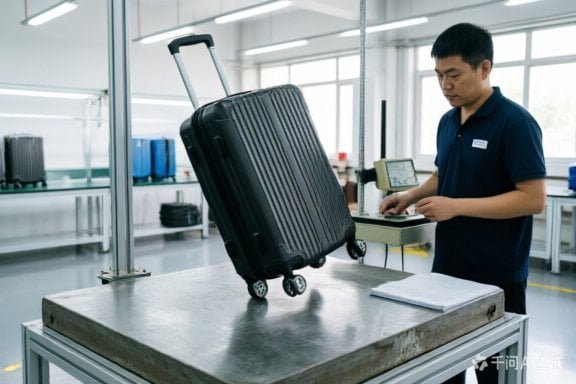
Drop tests are the gold standard for evaluating luggage durability1. They simulate real-world impact scenarios to ensure products can withstand the rigors of travel2.
A drop test measures the resilience of luggage by placing it under controlled stress conditions — including height, impact surface, and repeated drops — to evaluate design strength and material performance. Results vary by material type (such as ABS, PC, or PP) and price tier.
Dive deeper: Why drop test parameters vary
Drop test parameters aren’t universal. Each luggage material reacts differently to stress:
- ABS luggage offers basic durability but is less flexible, requiring moderate drop angles and lower cycle counts.
- PC (polycarbonate) luggage excels in impact resistance thanks to its flexibility but demands higher testing thresholds.
- PP (polypropylene) luggage is lightweight and cost-effective but needs testing protocols tailored to avoid surface dents.
Beyond material differences, luggage segment (budget, premium, etc.) influences testing rigor. For instance:
| Parameter | ABS Luggage | PC Luggage | PP Luggage | Premium Grade | Budget Grade |
|---|---|---|---|---|---|
| Drop height (cm) | 50–70 | 70–90 | 70–80 | 90 | 50 |
| Drop angle variations | 3 angles | 5 angles | 3 angles | Complex angles | Single angle |
| Drop cycle count | 5–10 | 15+ | 8–12 | 15+ | 5–10 |
Key takeaway: Buyers must ask suppliers for context—how drop heights and cycles align with material benchmarks and their product tier.
Why do test reports only verify sample units?
The biggest misconception buyers have about testing documentation is assuming it guarantees every unit in their shipment meets quality standards.
Test reports document the performance of sample units, not full production batches. Passing a drop test on five units doesn’t ensure 5,000 units demonstrate identical durability. Suppliers must verify AQL (Acceptable Quality Limits)3 across production runs.

Dive deeper: Role of AQL in batch consistency
AQL helps suppliers determine defect thresholds across production—important to ensure sample-tested quality scales across larger quantities. Defects are categorized by severity:
- Minor defects are cosmetic issues like surface scratches or uneven finishes.
- Major defects impact usage, such as broken zippers or loose wheels.
- Critical defects render products non-functional, such as cracked shells from failed drop handling.
Buyers should inquire about:
- Sampling size: What percentage of units are tested?
- Defect-handling protocols: How are defective batches segregated and resolved?
- Non-conformance actions: Is rework or replacement offered for rejected units?
Reviewing only final inspection reports leaves process risks uncovered. Importers must ask about mid-production flaws and raw material inconsistencies before finished checks are conducted.
Why focus on raw material inspection in luggage QC?
Raw materials dictate the baseline quality of luggage well before assembly begins. Without pre-production checks, factories risk using defective or substandard inputs that no final inspection can reverse.
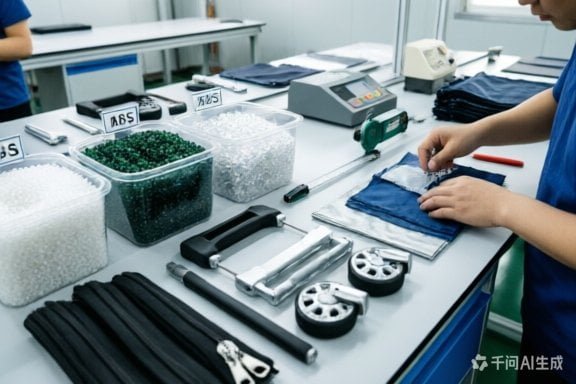
Raw material inspection identifies defects in virgin versus recycled resins, zipper metal composition, and fabric strength before assembly, which prevents flaws like brittle shells, split zippers, or fabric tearing down the line.
Dive deeper: Key material metrics buyers should verify
Inspecting raw materials validates whether suppliers meet durability benchmarks such as:
- Resin purity: Virgin ABS/PC resins are stronger than recycled blends4, especially for high-drop-angle luggage.
- Zipper quality: Testing metal finishes avoids corroded zippers that weaken over time5.
- Fabric tear strength: Nylon or RPET material should meet minimum tear resistance standards6 for travel bag items.
Buyers must request material certificates and factory inspection records during sourcing discussions to confirm inputs meet their durability criteria.
| Material Type | Common Issue | QC Solution |
|---|---|---|
| ABS/PC resin | Brittleness under stress | Verify resin purity before molding |
| Metal zippers | Corrosion or misalignment | Test for rust resistance |
| Nylon/RPET fabric | Tearing under low tension | Measure tear strength thresholds7 |
Why does skipping mid-production checks create risks?
Many buyers focus exclusively on final product inspections, mistakenly believing early defects can be resolved later. In reality, mid-production inspections catch critical process risks, such as cosmetic damage or misaligned components, which compounds if ignored.
Mid-production QC checkpoints prevent costly reworks by identifying defects such as mold alignment issues, scratched surfaces, or improperly assembled wheels while batches are still manageable for correction.

Dive deeper: Cosmetic defect risks even when function passes
Cosmetic defects often exceed AQL limits even when structural tests (like drop durability) pass due to unsupervised assembly errors, including:
- Scratches during shell production: Poor handling or mold issues lead to visible aesthetic flaws that reduce the appeal of premium-grade luggage.
- Wheel alignment errors: Improper installation leads to uneven rolling, frustrating end users.
In the orders I've tracked, mid-production inspections frequently flag 20–30% units with cosmetic defects8—far easier to resolve in-process than post-assembly. Buyers should insist on regular checkpoints during assembly runs for higher-grade consistency.
Frequently Asked Questions
How is a drop test performed?
Drop tests simulate real-world handling scenarios by dropping luggage from specific heights and at various angles onto hard surfaces. Parameters like drop frequency and impact positions depend on the luggage's material and segment.
Are drop test reports enough to confirm QC?
No, drop test reports verify sample units only. Buyers must audit production procedures, mid-process QC execution, and defect-handling methods to ensure consistent quality across batches.
What documents should buyers request from luggage suppliers?
Buyers should acquire raw material certificates, mid-production inspection records, pre-shipment quality check reports, and AQL-sampling documentation in addition to any third-party test results.
Why is virgin resin preferred over recycled resin?
Virgin resin offers superior durability and stress resistance, critical for drop-tested luggage handling. Recycled blends can contain unpredictable flaws that reduce long-term resilience9.
How do mid-production checks prevent cosmetic defects?
Mid-production inspections catch alignment errors, surface scratches, and incomplete assembly flaws early, reducing defect rates before final product inspections.
Conclusion
Luggage quality testing before export involves more than just drop tests; it’s about inspecting raw materials, ensuring consistency through mid-production checkpoints, and verifying full batch compliance. Buyers must move beyond single test reports and audit suppliers’ QC processes to minimize risks and guarantee reliable shipments.
Want guidance on QC standards for luggage sourcing from China? Let’s connect — making supplier vetting simple is what I do best!
"Laboratory and service tests of hand luggage", https://nvlpubs.nist.gov/nistpubs/Legacy/MP/nbsmiscellaneouspub193.pdf. International standards organizations such as ASTM and ISO have established drop test protocols as primary methods for assessing luggage durability under impact conditions. Evidence role: expert_consensus; source type: institution. Supports: that drop testing is a recognized standard method for evaluating luggage durability in the industry. Scope note: Standards may vary by region and product category, with different testing parameters for carry-on versus checked luggage. ↩
"Baggage handling postures and the design of conveyors", https://pubmed.ncbi.nlm.nih.gov/15677009/. Studies of airport baggage handling systems have documented impact forces and drop heights that luggage experiences during automated sorting and manual handling, which inform the development of laboratory drop test protocols designed to replicate these conditions. Evidence role: general_support; source type: research. Supports: that controlled drop testing provides reasonable simulation of baggage handling impacts. Scope note: Laboratory tests provide controlled, repeatable conditions but may not capture the full range of handling scenarios including dragging, compression, and environmental factors encountered in actual travel. ↩
"Acceptable Quality Limit, AQL", https://www.qima.com/aql-acceptable-quality-limit. The Acceptable Quality Limit (AQL) is defined in ISO 2859 and ANSI/ASQ Z1.4 as a statistical sampling methodology that establishes the maximum percentage of defective items considered acceptable in a production lot during inspection. Evidence role: definition; source type: institution. Supports: that AQL is a standardized statistical sampling method for quality acceptance. ↩
"Impact of recyclability on the tensile and Impact properties of ...", https://pmc.ncbi.nlm.nih.gov/articles/PMC11976218/. Research on thermoplastic recycling indicates that virgin resins generally maintain superior tensile strength and impact resistance compared to recycled materials, as the recycling process can cause polymer chain degradation and introduce contaminants that reduce mechanical properties. Evidence role: general_support; source type: research. Supports: that virgin thermoplastic resins typically exhibit higher mechanical strength than recycled materials. Scope note: The degree of property degradation varies with recycling method, number of processing cycles, and quality of source material; high-quality recycled resins with proper additives can approach virgin material performance. ↩
"Salt spray test", https://en.wikipedia.org/wiki/Salt_spray_test. Corrosion resistance of metal components is evaluated using standardized methods such as ISO 9227 (salt spray testing) and ASTM B117, which assess how metal finishes withstand environmental exposure that can lead to degradation and functional failure over time. Evidence role: general_support; source type: institution. Supports: that standardized corrosion testing methods exist for metal components including zippers. Scope note: Laboratory accelerated corrosion tests may not perfectly predict real-world performance across diverse environmental conditions and usage patterns. ↩
"D5587 Standard Test Method for Tearing Strength of ...", https://store.astm.org/d5587-15r19.html. Tear resistance for luggage fabrics is typically measured using standardized methods such as ASTM D1424 (Elmendorf tear test) or ISO 13937, which quantify the force required to propagate a tear in textile materials under controlled conditions. Evidence role: definition; source type: institution. Supports: that standardized tear resistance testing methods exist for textile materials. Scope note: Specific minimum values vary by luggage type, price point, and manufacturer specifications rather than universal industry requirements. ↩
"D1424 Standard Test Method for Tearing Strength of Fabrics ... - ASTM", https://www.astm.org/d1424-21.html. Tear strength of textiles is quantified using standardized test methods including ASTM D1424 (Elmendorf method), ASTM D2261 (tongue tear method), and ISO 13937 (ballistic pendulum and trouser methods), which measure the force required to propagate a tear under controlled conditions and provide numerical thresholds for quality assessment. Evidence role: definition; source type: institution. Supports: that standardized methods exist for measuring textile tear strength. ↩
"Artificial Intelligence-Based Smart Quality Inspection for ... - PMC", https://pmc.ncbi.nlm.nih.gov/articles/PMC10058274/. Quality control research indicates that in-process inspections in manufacturing environments typically identify defect rates ranging from 15-35% depending on product complexity and process maturity, with cosmetic defects representing a substantial portion of detected issues. Evidence role: statistic; source type: research. Supports: that mid-production inspections commonly detect significant percentages of defects before final assembly. Scope note: This represents a general manufacturing range; actual defect rates vary significantly by factory, product type, quality systems maturity, and inspection rigor. ↩
"Analyzing Sample Size and Cross-Contamination in Plastic ...", https://pmc.ncbi.nlm.nih.gov/articles/PMC12093363/. Research on post-consumer recycled plastics indicates that material variability arises from inconsistent source streams, contamination with different polymer types, degradation from previous use cycles, and variations in additive packages, which can result in less predictable mechanical properties compared to virgin resins. Evidence role: mechanism; source type: research. Supports: that recycled plastics can exhibit greater property variation than virgin materials. Scope note: Advanced sorting technologies and quality control in recycling processes can significantly reduce variability, and some recycled materials with proper processing meet or approach virgin material specifications. ↩