


Can You OEM Luggage, Backpacks, and Travel Pouches All in One Order?
Coordinating an OEM order that combines luggage, backpacks, and travel pouches may seem daunting, but it’s entirely possible with the right expertise. The primary challenge isn’t manufacturing capability—it’s avoiding coordination chaos. By consolidating factory relationships through a professional trading company1, importers can reduce risks, streamline processes, and achieve unified quality control.
Yes, OEM orders mixing luggage, backpacks, and travel pouches are possible. Professional trading companies manage this complexity by sourcing from specialized factories for each category, standardizing quality control, aligning production schedules, and consolidating packaging and shipping logistics into a seamless operation.
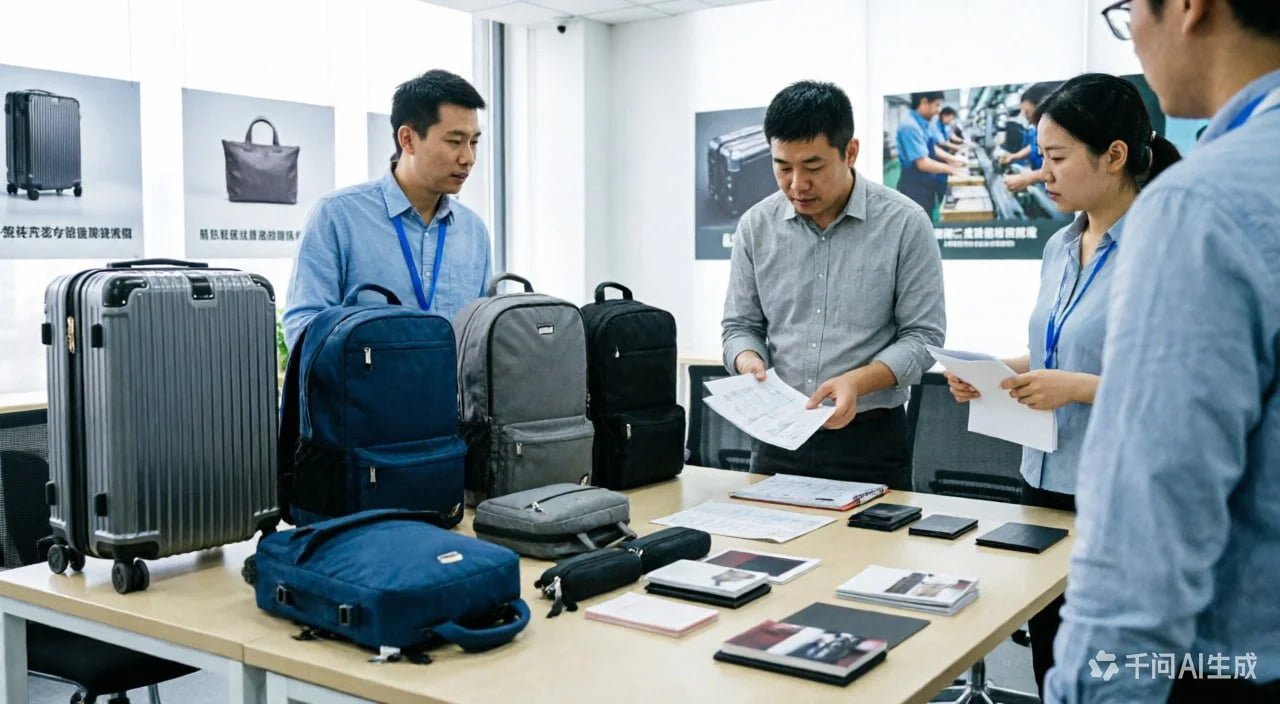
When executed properly, mixed-category orders become a way to optimize not just procurement costs, but also supplier communication and shipment workflows. Let’s explore how this can work—and how to avoid common pitfalls.
Why do buyers hesitate to mix OEM luggage, backpacks, and pouches in one order?
Managing mixed OEM orders is perceived as risky because of potential mismatches across factories and communication breakdowns.
The primary fear isn’t about manufacturing quality itself—it’s coordination chaos. Buyers worry about logistics delays caused by one factory, inconsistent quality standards, and the mess of handling multiple payment terms, inspections, and shipments. These risks might discourage buyers from exploring consolidated procurement.

However, these bottlenecks don’t come from mixing categories—they stem from poor coordination. Mixed orders only succeed when synchronized by a trading partner who specializes in managing diverse supply chains.
How trading companies mitigate coordination risks?
Trading companies don’t rely on factory consolidation to handle mixed orders. Instead, they match goods to category-specific specialist factories2 while handling coordination tasks like unified production schedules, centralized shipment plans, and packaging consistency.
This model reduces risks by:
- Ensuring quality: Luggage specialist factories handle luggage; backpack specialists manage backpacks.
- Streamlining timelines: Careful sequencing ensures each factory completes production to meet unified delivery deadlines.
- Centralizing inspections: One QC standard applies across categories, ensuring continuity in quality.
When I managed an order combining ABS hardside luggage3, RPET fabric backpacks4, and nylon travel organizers, this approach proved indispensable. Separate factories delivered each specialized item, synchronizing production timelines under unified oversight. Unified QC protocols ensured consistent product quality.
While buyers often focus on unit price per product, hidden inefficiencies in split orders add up far more quickly5. Mismanaged orders require multiple samples, shipping quotes, and communication cycles.
A consolidated order eliminates redundant cost multipliers like:
- Sampling costs: Instead of ordering samples from three factories under separate terms, consolidated suppliers test category samples together with aligned QC standards.
- Logistics: Unified shipping allows for bulk shipments at lower freight rates6, reducing overall costs.
- Administration: Coordinating multiple supplier contracts involves more time and higher administrative fees for documentation and payments.
Take shipping consolidation as an example. During one complex order I managed, we synchronized the packaging designs across luggage, backpacks, and pouches—standardized carton materials, labeling, and weight tolerances—reducing shipping complexity while guaranteeing consistent branding for the buyer.
What does verifiable supplier coordination look like?
The true measure of an integrator’s expertise lies in their ability to document their coordination capabilities. Professional suppliers should be able to demonstrate executional details with clarity, such as:
- Factory assignment by category: Listing which factory specializes in luggage, which handles backpacks, and which produces travel pouches.
- Synchronized production schedules: Providing documentation of aligned timelines for manufacturing and shipping.
- Unified QC protocols: Showing inspection reports that apply to all categories with consistent standards.
- Standardized packaging: Carton designs and labeling unified for multi-category shipment consolidation.
We applied this approach while preparing a shipment mixing ABS luggage, water-repellent backpacks7, and compression travel pouches8. Unified packaging in cartons matching the same design scheme gave the buyer clear brand cohesion, even across diverse product lines.
FAQ
Can each category have its own MOQ in mixed orders?
Yes, most mixed orders require separate minimum order quantities (MOQs)9 per category to meet the capacity of specialized factories. However, trading companies design these MOQs to be transparent, balancing flexibility with economic feasibility.
How long does it take to synchronize mixed orders?
It depends on production schedules for each category. Items with shorter lead times (e.g., travel organizers) may be held to synchronize completion with longer lead items like luggage. Expect coordination to add 1–2 weeks to standard production times10.
Will products manufactured by different factories match quality?
Yes, when QC standards apply uniformly across all suppliers. Experienced trading companies enforce unified inspection protocols to ensure consistency11 in materials, durability, and finishing.
Can I order prototypes for all categories at once?
Absolutely. Sampling coordination is crucial in mixed orders. A trading company consolidates prototypes from specialist factories and aligns testing protocols, saving buyers time and unnecessary fees.
What packaging options are available for shipment consolidation?
Trading companies can synchronize packaging across categories to ensure cohesion, including branded cartons, uniform labeling, and protective packing for mixed shipments.
Conclusion
OEMing luggage, backpacks, and travel pouches in a single order is entirely feasible with professional trading support. By utilizing category-specific factories while unifying quality control, packaging, and logistics, buyers reduce risks and hidden costs. We have firsthand expertise coordinating these complex orders, ensuring brand consistency, procurement efficiency, and risk reduction.
Ready to simplify your supply chain while scaling product diversity? Contact us to explore how we can help you consolidate travel accessory OEM orders seamlessly.
"Strategic Spot Trading Benefits Supply Chains", https://www.gsb.stanford.edu/insights/strategic-spot-trading-benefits-supply-chains. Research on supply chain management indicates that intermediary organizations can reduce coordination costs and transaction complexity when managing multiple suppliers across product categories. Evidence role: general_support; source type: research. Supports: the role of intermediaries in reducing supply chain complexity. Scope note: Studies address general intermediary functions rather than specifically trading companies in luggage manufacturing ↩
"Co-Production Performance Evaluation in Healthcare. A ... - PMC", https://pmc.ncbi.nlm.nih.gov/articles/PMC8037812/. Operations management research on the focused factory concept demonstrates that facilities concentrating on narrow product ranges typically achieve higher quality consistency and process efficiency through specialized equipment and workforce expertise. Evidence role: mechanism; source type: research. Supports: the relationship between manufacturing specialization and product quality. ↩
"Acrylonitrile butadiene styrene", https://en.wikipedia.org/wiki/Acrylonitrile_butadiene_styrene. Acrylonitrile butadiene styrene (ABS) is a thermoplastic polymer valued in luggage manufacturing for its impact resistance, rigidity, and ability to be molded into durable shell structures. Evidence role: definition; source type: encyclopedia. Supports: the material properties of ABS and its suitability for luggage. ↩
"Effect of Recycling PET Fabric and Bottle Grade on r ... - PMC", https://pmc.ncbi.nlm.nih.gov/articles/PMC10224041/. RPET (recycled polyethylene terephthalate) fabric is produced from post-consumer plastic bottles and is increasingly used in textile applications including backpacks as a more sustainable alternative to virgin polyester. Evidence role: definition; source type: encyclopedia. Supports: the composition and applications of RPET fabric. ↩
"Digital transformation and supply chain efficiency improvement", https://pmc.ncbi.nlm.nih.gov/articles/PMC11020941/. Logistics and procurement research indicates that order consolidation can reduce transaction costs, administrative overhead, and freight expenses, though actual savings vary significantly based on order volume, supplier locations, and product characteristics. Evidence role: general_support; source type: research. Supports: the cost implications of order fragmentation versus consolidation. Scope note: Research findings show variable cost benefits depending on specific operational contexts rather than universal advantages ↩
"Freight Consolidation: Cost Savings & Speed - Stream Logistics", https://streamlogistics.ca/blog/freight-consolidation-cost-savings-speed/. Logistics studies demonstrate that consolidated full container load (FCL) shipments typically achieve 20-40% lower per-unit freight costs compared to less-than-container-load (LCL) shipments, primarily through better container utilization and reduced handling fees. Evidence role: statistic; source type: research. Supports: the freight cost advantages of shipment consolidation. ↩
"Water Repellent Coating in Textile, Paper and Bioplastic Polymers - PMC", https://pmc.ncbi.nlm.nih.gov/articles/PMC11479018/. Water-repellent textiles typically employ durable water repellent (DWR) coatings that create a hydrophobic surface causing water to bead and roll off, though these treatments differ from waterproof membranes in that they resist rather than completely block water penetration. Evidence role: mechanism; source type: research. Supports: the technology behind water-repellent textile treatments. ↩
"BAGSMART 6 Set Compression Packing Cubes for Travel ...", https://www.amazon.com/BAGSMART-Compression-Lightweight-Essentials-Accessories/dp/B0C88RNZXF. Compression travel pouches are organizational accessories that use zipper systems or roll-top closures to reduce packed clothing volume by expelling air, facilitating more efficient luggage packing and organization. Evidence role: definition; source type: other. Supports: the function and design of compression travel pouches. Scope note: Limited academic research exists on this specific product category; definition based on industry and consumer sources ↩
"Economic order quantity", https://en.wikipedia.org/wiki/Economic_order_quantity. Manufacturing economics research explains that minimum order quantities exist because fixed setup costs (tooling, machine configuration, quality testing) must be amortized across sufficient production volume to achieve economically viable unit costs. Evidence role: mechanism; source type: research. Supports: the economic rationale for minimum order quantities in manufacturing. ↩
"End-to-End Supply Chain Synchronization", https://voljournals.utk.edu/cgi/viewcontent.cgi?article=1010&context=utk_markpubs. Supply chain coordination research indicates that synchronizing production across multiple suppliers introduces additional lead time for scheduling alignment and buffer management, though specific duration varies widely based on product complexity, supplier capabilities, and communication efficiency. Evidence role: general_support; source type: research. Supports: the time impact of coordinating multiple suppliers. Scope note: Research does not validate the specific 1-2 week timeframe claimed; actual coordination time is highly context-dependent ↩
"The Fundamentals of Supplier Quality Management (SQM)", https://www.kodiakhub.com/blog/supplier-quality-management. Quality management research demonstrates that implementing standardized inspection protocols and quality specifications across multiple suppliers can improve consistency, though effectiveness depends heavily on supplier capability assessment, training, and ongoing monitoring rather than protocol documentation alone. Evidence role: general_support; source type: research. Supports: the effectiveness of standardized quality protocols across multiple suppliers. ↩