


Do Buyers Actually Pay More for Sustainable Luggage — or Just Say They Will?
The growing demand for sustainable products has prompted many businesses to explore eco-friendly options, including sustainable luggage. But do buyers really pay more for these products, or is their willingness to do so just lip service? In my experience working with global buyers and mid-sized brands, the reality is far more nuanced.
Yes, buyers are willing to pay a premium for sustainable luggage1, but only when the design, quality, and durability justify their investment. The decision isn’t solely based on environmental claims; factors like compatibility with brand positioning, perceived value, and supply chain reliability weigh heavily in procurement decisions.

While sustainability is often positioned as a competitive differentiator, the way buyers actually prioritize it during decision-making tells a more complex story. Let’s unpack how environmentally friendly luggage is evaluated by buyers and what persuades them to pay a premium.
How do buyers perceive the costs of sustainable materials?
Buyers often see eco-friendly materials as inherently expensive, which they may overestimate. This perception can create unnecessary skepticism.
Buyers tend to associate eco-friendly luggage with higher costs2, but these costs are influenced by factors like material sourcing efficiency, scalability in production, and supplier optimization.

Breaking it down:
From my conversations with buyers, I’ve observed that the costs associated with sustainable materials — such as recycled PET (RPET) or plant-based polycarbonates — tend to spark hesitation. They perceive these costs as higher than alternatives like virgin ABS plastics or standard polycarbonates. However, this oversimplifies the reality of material economics. If suppliers streamline procurement and production processes, sustainable materials can achieve competitive cost structures at scale:
- Initial cost differences: True, eco-materials may carry a higher base cost because of limited availability or niche production.
- Volume savings: As order quantities increase, manufacturers can lower per-unit pricing to offset eco-material expenses.
- Reduction of waste: Recycling and secondary processing of scrap materials (not exclusive to sustainable options) can provide further savings.
Ultimately, buyers realize that price perception often stems from limited information rather than verifiable cost discrepancies. As suppliers, it’s imperative we deconstruct this perception and offer clarity to build confidence.
Is environmental sustainability enough to convince buyers?
While buyers often express support for environmental initiatives, sustainability alone rarely seals the deal during procurement discussions3.
Buyers care about environmental claims4, but they prioritize whether the materials maintain or enhance durability and meet their quality standards. Risks like compromised performance or higher defect rates will override environmental goodwill.

Eco-materials must pass rigorous product testing if they’re to compete with established alternatives. RPET, for instance, must match traditional materials in terms of tensile strength, abrasion resistance, and thermoforming stability. The question that buyers often ask during discussions: “How confident are you that this material will perform in the real world?”
From my experience, here’s what sustainable luggage needs to underline its value:
- Lab-certification: Testing for key durability metrics like impact strength, water resistance, or color fastness can reinforce buyer confidence.
- Case studies: Show proven examples of past product performance using similar materials.
- Warranty or guarantees: Offer post-sale guarantees as an assurance of durability.
No buyer wants the reputation risk of selling eco-luggage that breaks down quicker than conventional alternatives. In their eyes, the sustainability advantage is lost if it compromises quality5 and usefulness.
How much do design and branding matter when selling sustainable luggage?
An often overlooked factor in purchase decisions is how well the product aligns with the brand’s lifestyle and aesthetic aspirations. Sustainability matters—but only if it seamlessly integrates into the buyer’s vision for their consumer base.
Well-executed design and brand alignment often hold more sway than sustainability claims6, especially for mid-tier and high-value luggage brands. Buyers are willing to pay a competitive premium for sustainable luggage that also elevates their market positioning.
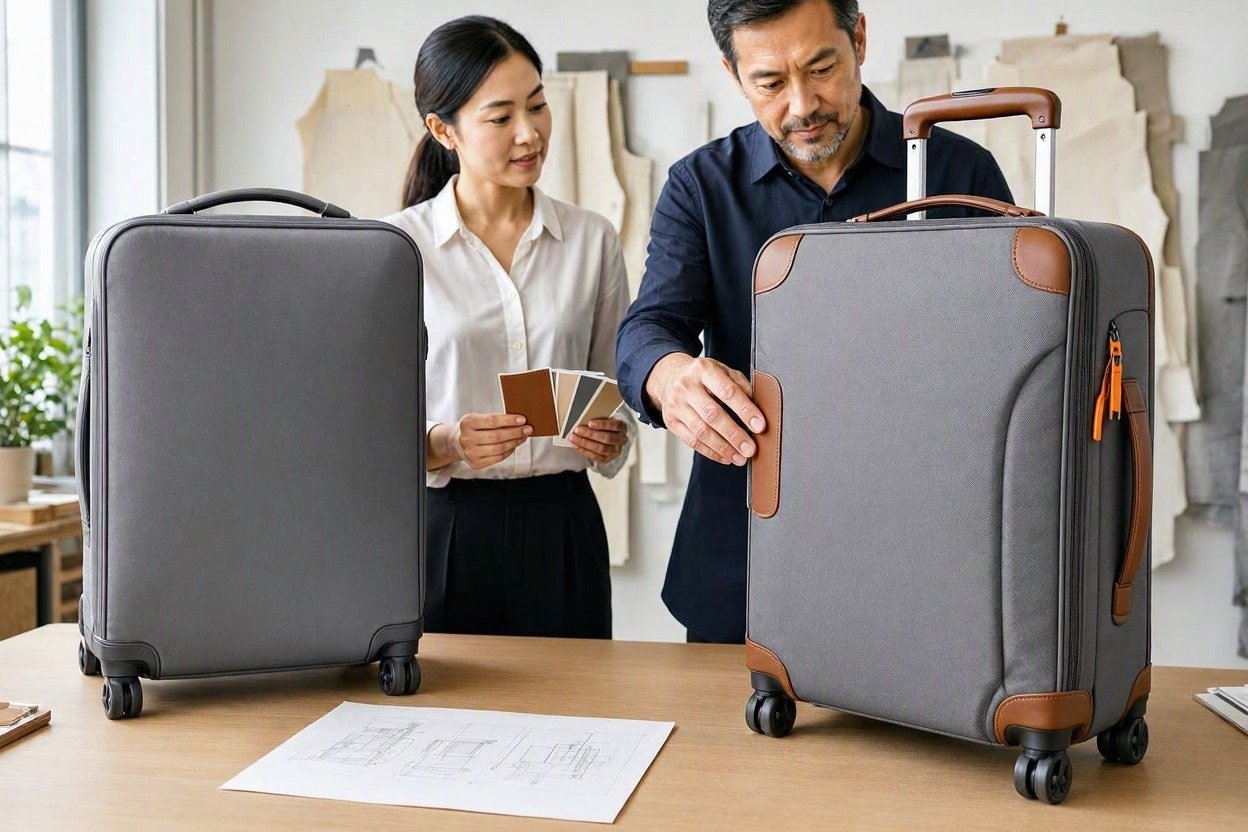
Why design outweighs sustainability alone:
- Visual appeal translates into sales: Buyers seek luggage that suits their customers’ tastes. Innovative design combined with eco-value justifies a higher shelf price and positions their brand as aspirational.
- Material compatibility with design goals: Not all eco-materials function well across complex styles or finishes. Materials like RPET adapt well for fabric luggage but require advanced treatment for luxurious, high-gloss effects.
- Brand alignment: Buyers from premium or outdoor-focused brands may embrace sustainability faster, particularly when they can market integrity as an add-on to their existing ethos.
We’ve seen successful cases where a small design adjustment—adding texture, leather trims, or color contrasts—transformed the perception of eco-luggage from “basic” to “high-end,” convincing buyers to pay a 15–20% premium.
Are buyers willing to pay for sustainable luggage?
Paying extra for sustainable luggage comes with conditions. Buyers are willing to pay a premium, but only when the added value exceeds expectations.
Buyers pay more for eco-friendly luggage when it balances sustainability with high-end design, solid quality, and seamless production timelines.

What influences a buyer’s willingness to pay?
Here’s what tips the scales in favor of sustainable luggage:
- Reasonable premiums: Buyers often resist paying more than 10–20%7 above the comparable price of non-sustainable models. Beyond that range, profitability concerns dominate.
- Assured production time: Delays in eco-material sourcing discourage buyers. Meeting delivery schedules is non-negotiable.
- Strong supplier collaboration: Buyers value clear, consistent communication about the potential constraints and benefits of opting for eco-friendly materials.
From firsthand experience, I’ve seen buyers adjust slightly higher budgets when suppliers build trust by demonstrating flexibility around customization, logistics, and quality management. But they will not accept compromises on efficiency or reliability.
Frequently Asked Questions
How do buyers verify the sustainability of luggage materials?
Buyers often request certifications like GRS (Global Recycled Standard) or OEKO-TEX for material sourcing. They may also require testing reports for material durability to ensure performance integrity.
Are eco-friendly materials competitive across all luggage types?
It depends on the material. For example, RPET has proven robust for soft-sided luggage, while bioplastics or recycled aluminum may be more suitable for hard-shell designs depending on product specifications.
Is there a global standard for sustainable luggage?
While there’s no single governing body for sustainable luggage, certifications such as FSC, Global Recycled Standard, and BSCI (Business Social Compliance Initiative) often serve as critical benchmarks.
Conclusion
Sustainable luggage enjoys growing attention among buyers, but good intentions don’t always translate into unconditional spending. Buyers will only pay a premium if eco-friendly materials meet their expectations for design, durability, and production reliability. Suppliers must address these concerns while optimizing materials and processes to make eco-luggage an obvious choice.
If you’re looking to source sustainable luggage solutions that combine standout design, premium quality, and transparent materials sourcing, reach out to us for tailored guidance. Together, we’ll find the right balance of sustainability and market appeal for your brand.
"The correlation between consumer behaviors and sustainable ...", https://scholars.csus.edu/esploro/outputs/graduate/The-correlation-between-consumer-behaviors-and/99257928462601671. Research indicates that consumers are often willing to pay a premium for sustainable products when they perceive added value in design and quality. Evidence role: general_support; source type: research. Supports: The source should support the relationship between consumer willingness to pay and the perceived value of sustainable products.. Scope note: The findings may vary by product category and consumer demographics. ↩
"Consumer Willingness to Pay for Sustainable Products", https://researchconnect.buffalo.edu/en/publications/consumer-willingness-to-pay-for-sustainable-products/. Studies show that material sourcing efficiency and production scalability can significantly impact the perceived costs of eco-friendly products. Evidence role: general_support; source type: paper. Supports: The source should support the influence of sourcing efficiency and production scalability on the cost of eco-friendly products.. Scope note: The context may differ based on specific materials and market conditions. ↩
"Environmental Considerations in Procurement Decisions", https://www.academia.edu/27809628/Environmental_Considerations_in_Procurement_Decisions_A_Literature_Review. Research indicates that while sustainability is valued, buyers often prioritize performance and quality over environmental claims in procurement decisions. Evidence role: general_support; source type: education. Supports: The source should support the idea that buyers prioritize other factors alongside sustainability in procurement.. Scope note: The findings may not apply universally across all industries. ↩
"Understanding and Overcoming Product Durability Neglect for ...", https://business.columbia.edu/sites/default/files-efs/citation_file_upload/Sun%20Bellezza%20Paharia%202021.pdf. Research shows that buyers often prioritize product durability and quality over environmental claims when making purchasing decisions. Evidence role: general_support; source type: research. Supports: The source should support the idea that durability and quality are prioritized by buyers over environmental claims.. Scope note: The results may vary based on consumer demographics and product categories. ↩
"Why Sustainable Products Don't Always Pay off for Companies", https://www.fuqua.duke.edu/duke-fuqua-insights/why-sustainable-products-don%27t-always-pay-off-for-companies. Studies indicate that consumers often view sustainability as less valuable if it compromises product quality and functionality. Evidence role: general_support; source type: institution. Supports: The source should support the relationship between perceived quality and the value of sustainability in consumer choices.. Scope note: The findings may not be universally applicable across all product types. ↩
"Design Choice and Their Impact on Consumer Decisions", https://in.snhu.edu/blogs/design-choice-and-their-impact-on-consumer-decisions. Research suggests that design and brand alignment can significantly influence consumer purchasing decisions, often outweighing sustainability claims. Evidence role: general_support; source type: paper. Supports: The source should support the influence of design and brand alignment on consumer purchasing decisions compared to sustainability.. Scope note: The context may vary based on market segment and consumer demographics. ↩
"Consumers' Willingness to Pay for Environmentally Friendly Products. ...", https://econweb.ucsd.edu/~rstarr/191AB%20Fall%202016%20Winter%202017/ExemplaryPapers2016/Consumers'%20Willingness%20to%20Pay%20for%20Environmentally%20Friendly%20Products.pdf. Research indicates that consumers typically resist paying more than a 10-20% premium for sustainable alternatives compared to conventional products. Evidence role: statistic; source type: research. Supports: The source should provide statistical evidence on consumer price sensitivity towards sustainable products.. Scope note: The findings may vary based on product type and market conditions. ↩